


Today we’d like to introduce you to Jacob Kloster.
Hi Jacob, it’s an honor to have you on the platform. Thanks for taking the time to share your story with us – to start maybe you can share some of your backstory with our readers?
Our Community Kitchen is the first shared kitchen in the Phoenix metro area, originally established in 2009. I’m the third owner of the kitchen, but before that, I was actually a client here for eight years.
During that time, I built and operated two food trucks out of this kitchen, so I experienced firsthand what this space can do for a small food business. It wasn’t just a place to cook—it was a foundation that allowed me to grow, stay consistent, and operate professionally.
When I learned the business was for sale, as the previous owner, Candice, was preparing to retire, I made a very intentional decision. I didn’t want to see someone come in and make drastic changes that would disrupt what made this place valuable. I knew what the kitchen meant to the people working in it, because I had been one of them.
So for me, the only way to protect and build on that was to step in and take it on myself.
I’ve always been passionate about supporting small businesses, but this gave me the opportunity to do it in a much bigger way. Now, instead of just running my own operation, I’m helping create an environment where dozens of food entrepreneurs can grow, refine their processes, and build something sustainable.
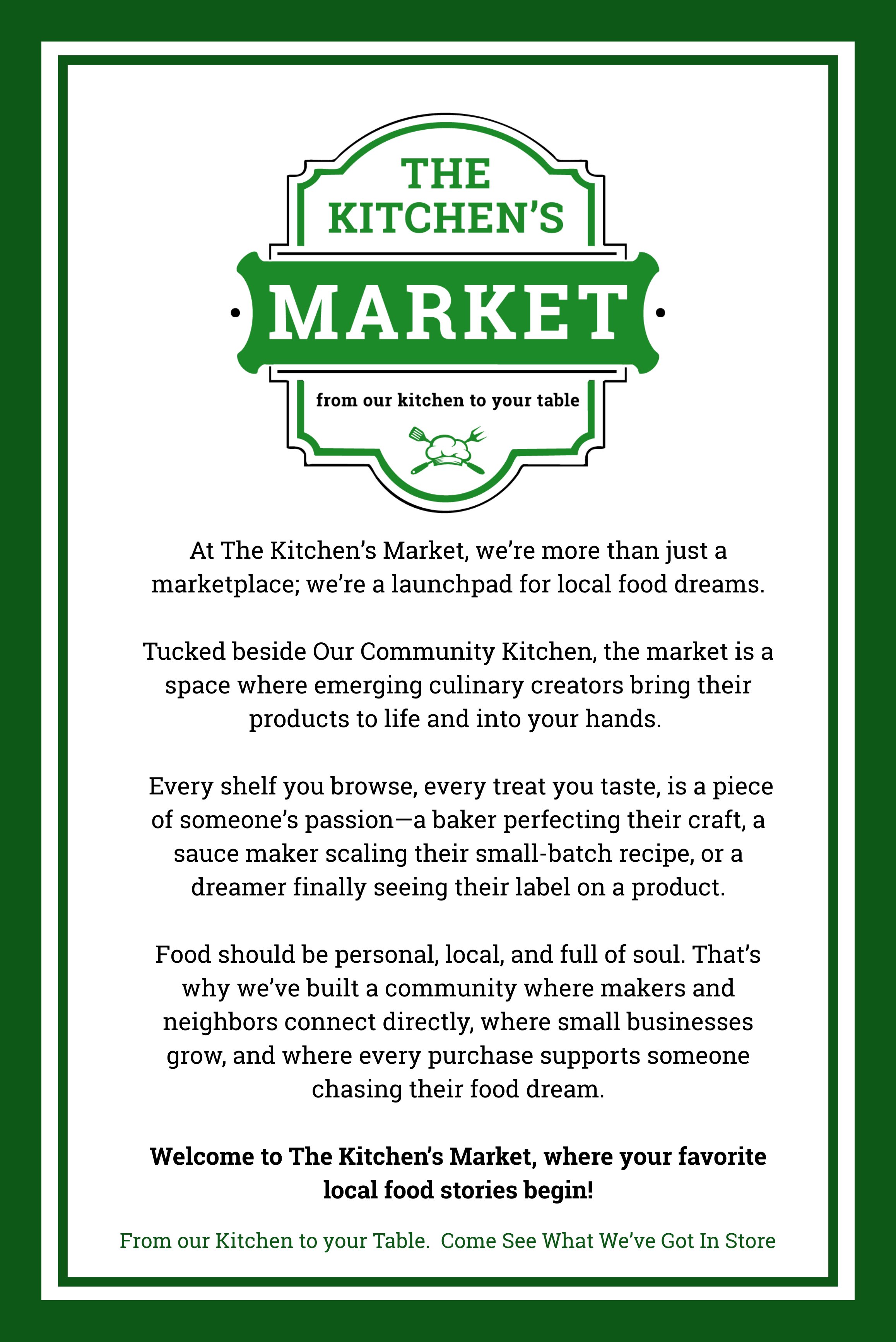
Since taking over, the focus has been on strengthening what already worked while introducing more structure and intentional systems—things that help businesses not just start, but actually scale. That includes everything from how the kitchen operates day-to-day to programs like The Kitchen’s Market, which gives our clients real opportunities to get their products in front of customers and start generating revenue.
At the end of the day, my path into this wasn’t theoretical—it was built from experience. I’ve been in the position our clients are in, and that perspective drives how we run the kitchen today.
I’m sure it wasn’t obstacle-free, but would you say the journey has been fairly smooth so far?
It definitely hasn’t been a completely smooth road—and I think that’s true for any business that’s actually trying to do something meaningful.
One of the biggest challenges was stepping into an existing operation with a long history. Our Community Kitchen had already been around for years, which is a great thing—but it also means there are established habits, expectations, and ways of doing things. Balancing respect for what was built while also introducing more structure and higher operational standards was not always easy.
Any time you raise expectations—especially around things like sanitation, scheduling, and accountability—you’re going to get some resistance. Not everyone is ready for that level of discipline, even if it ultimately benefits them.
Another challenge is the nature of a shared kitchen itself. You’re not just managing a space—you’re managing an ecosystem. One person cutting corners can impact everyone else, so maintaining consistency across multiple businesses, personalities, and experience levels requires constant attention.
There’s also the reality that many food entrepreneurs come in at very different stages. Some are highly organized and ready to scale, while others are still learning the basics. Creating systems that support both, without lowering standards, has been an ongoing balancing act.
But those challenges are also what shaped how we operate today.
They forced us to be very clear about who we’re for, what we expect, and how we run the kitchen. And over time, that clarity has actually made things stronger. The clients who stay and succeed here are the ones who embrace that structure, and that’s what creates a better environment for everyone.
So no, it hasn’t been perfectly smooth—but it’s been intentional, and that’s what matters.
Alright, so let’s switch gears a bit and talk business. What should we know?
Our Community Kitchen is a shared-use commercial kitchen, but more importantly, it’s a structured environment built for serious food entrepreneurs.
We provide licensed kitchen space for a wide range of businesses—from food trucks and caterers to packaged food brands—but what really defines us is how we operate. We specialize in creating an environment where production discipline, sanitation standards, and operational structure are part of the daily workflow. That’s what allows our clients to move beyond the early stages and start building scalable, sustainable businesses.
What sets us apart is that we’re not just offering access—we’re offering accountability and systems.
A lot of shared kitchens focus on flexibility, which sounds good on the surface, but often leads to inconsistency and operational breakdowns. We’ve taken a different approach. We’ve built clear expectations around how the kitchen is used, how it’s maintained, and how time is managed. That structure creates a more professional environment, and it attracts founders who are serious about growth.
In addition to the kitchen itself, we created The Kitchen’s Market as an extension of that philosophy.
The Kitchen’s Market is designed to give our clients real opportunities to sell their products, test demand, and build customer relationships. One of the biggest gaps for early-stage food businesses is access to market—not just producing a product, but actually getting it in front of people. This program helps bridge that gap by creating a consistent, structured platform for our clients to show up as brands, not just producers.
Together, these two pieces—Our Community Kitchen and The Kitchen’s Market—work hand in hand. One builds the operational foundation, and the other creates opportunities for real-world execution.
Brand-wise, what I’m most proud of is the culture we’ve built.
We’ve created an environment where expectations are clear, standards are high, and the people who thrive here genuinely support each other. It’s not chaotic, and it’s not casual—it’s intentional. And that attracts a different level of entrepreneur.
What I want readers to understand is that we’re here for people who are ready to take their business seriously. You don’t have to have everything figured out, but you do need to be willing to operate with discipline and consistency.
Because at the end of the day, success in the food industry isn’t just about having a great product—it’s about how well you can execute, over and over again. And that’s exactly what we help our clients build.
We’d be interested to hear your thoughts on luck and what role, if any, you feel it’s played for you?
I think luck plays a role, but not in the way people sometimes think.
There are definitely moments where timing matters. For example, the opportunity to purchase the kitchen came at the right time—Candice was ready to retire, and I was in a position where I could step in. That’s something you could call “good luck.”
But at the same time, I had spent eight years working out of this kitchen, building my own businesses, learning the space, and understanding exactly how it operated. So when that opportunity came, I was actually prepared to take it.
To me, that’s really what luck is—it’s when preparation meets opportunity.
On the flip side, there have been challenges that could easily be seen as “bad luck,” whether it’s dealing with the complexities of running a shared environment, navigating different client expectations, or making difficult decisions to raise standards. But those situations usually end up shaping the business in a positive way if you handle them correctly.
So I don’t rely on luck, but I do recognize timing when it shows up.
And I think the most important thing is putting yourself in a position where, when those moments come, you’re ready to act on them.
Pricing:
- Pricing depends on need of service and storage
Contact Info:
- Website: https://www.OurCommunityArizona.com
- Instagram: https://www.instagram.com/ourcommunitykitchenaz/
- Facebook: https://www.facebook.com/TheKitchensMarket
- Other: https://www.instagram.com/thekitchensmarket/
Popular
-

Isaac Navias on How AI Search Is Reshaping Local Discovery and Building Businesses for Freedom
-

Phoenix’s Most Inspiring Stories
-

From Manuscript to Meaning: How Lauren Wise Is Helping Authors Turn Stories into Lasting Impact
-

Designing the Invisible: Jennifer Hassett on the Rise of Fully Staffed Luxury Households in Phoenix
