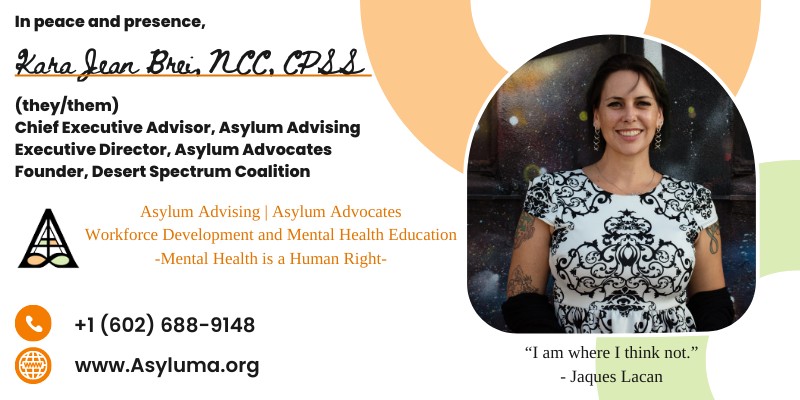
Today we’d like to introduce you to Kara Jean Brei.
Hi Kara, so excited to have you with us today. What can you tell us about your story?
I have been working in the field of mental health since 2008. I started in a lockdown facility for adjudicated youth, moved to the State Hospital, and ended up as a maximum security mental health associate in the 4th Ave Jail. After COVID obliterated my program there, and I was boots on the ground during the George Floyd protests, I could no longer stand to stay within the correctional setting and witness how inmates were treated on the inside.
I decided that I was going to go out on my own with a mission to prevent disenfranchised populations from ending up in the system. I figured the best way to do that would be to develop organizations that address mental health disparities and that is exactly what I did.
Can you talk to us a bit about the challenges and lessons you’ve learned along the way? Looking back would you say it’s been easy or smooth in retrospect?
Our growth has been exponential.
As a mother of 4, it has been difficult to dedicate my time to aggressive grant-writing schedules. But with the help of my partner, Sheree Ware, CPSS, we have been able to write three grants and secure one federal grant. We have four employees on payroll now and expect to hire two more in the next two months. That is all within the first year since we acquired 501c3 nonprofit status.
Alright, so let’s switch gears a bit and talk business. What should we know?
Asylum Advocates is a mental health access and equity non-profit. Our mission is to deliver mental health services to the underserved. Our vision is a world where holistic emotional support is universally available.
We specialize in disenfranchised populations, including racial disparities, LGBTQIAP2S+ and allies, non-traditional relationships, and sexual concerns. We have a nested coalition that serves LGBTQ youth in the hopes of preventing homelessness and addiction in a population whose risk is disparately high.
Where do you see things going in the next 5-10 years?
We are moving from an abstinence-only vision of treating substance use disorder to a harm reduction model. This means meeting people where they are at, whether they are using substances or not, and then offering assistance in a gradual way that places human connection at the foundation.
Also, the internet, social media, and porn addiction are becoming epidemics. We see ourselves as leaders in an initiative to bring back in-person human connection and connection to the natural world as a solution for mental health conditions where screen time is the cause.
Pricing:
- $40/hour for Peer Support
- $80/hour for Therapy
- $28 per class
- Scholarships for People Who Use Drugs
Contact Info:
- Website: www.AsylumA.org
- Facebook: https://www.facebook.com/desertspectrum
- Linkedin: https://www.linkedin.com/in/kara-jean-brei-mc-ncc-a3bbb5216/
- Twitter: https://twitter.com/AsylumAdv
- Other: https://www.asyluma.org/ds-coalition.html


 Image Credits
McKay Jaffe (I Must Be Dead Photography) and Phoebe Phobia