We recently had the chance to connect with Bryant Eugene Vazquez and have shared our conversation below.
Good morning Bryant Eugene, we’re so happy to have you here with us and we’d love to explore your story and how you think about life and legacy and so much more. So let’s start with a question we often ask: What is a normal day like for you right now?
Alas, I have a day job. I work 100% remotely, which has its advantages. Normal work day Mon-Fri begins with a quick hit of dopamine and terror via social media. I check to see if there’s anything new and horrible to be aware of. I turn my AC up from 67 degrees to 73. I set my drip coffee while I take a piss and then stretch out. Sign into my work computers.
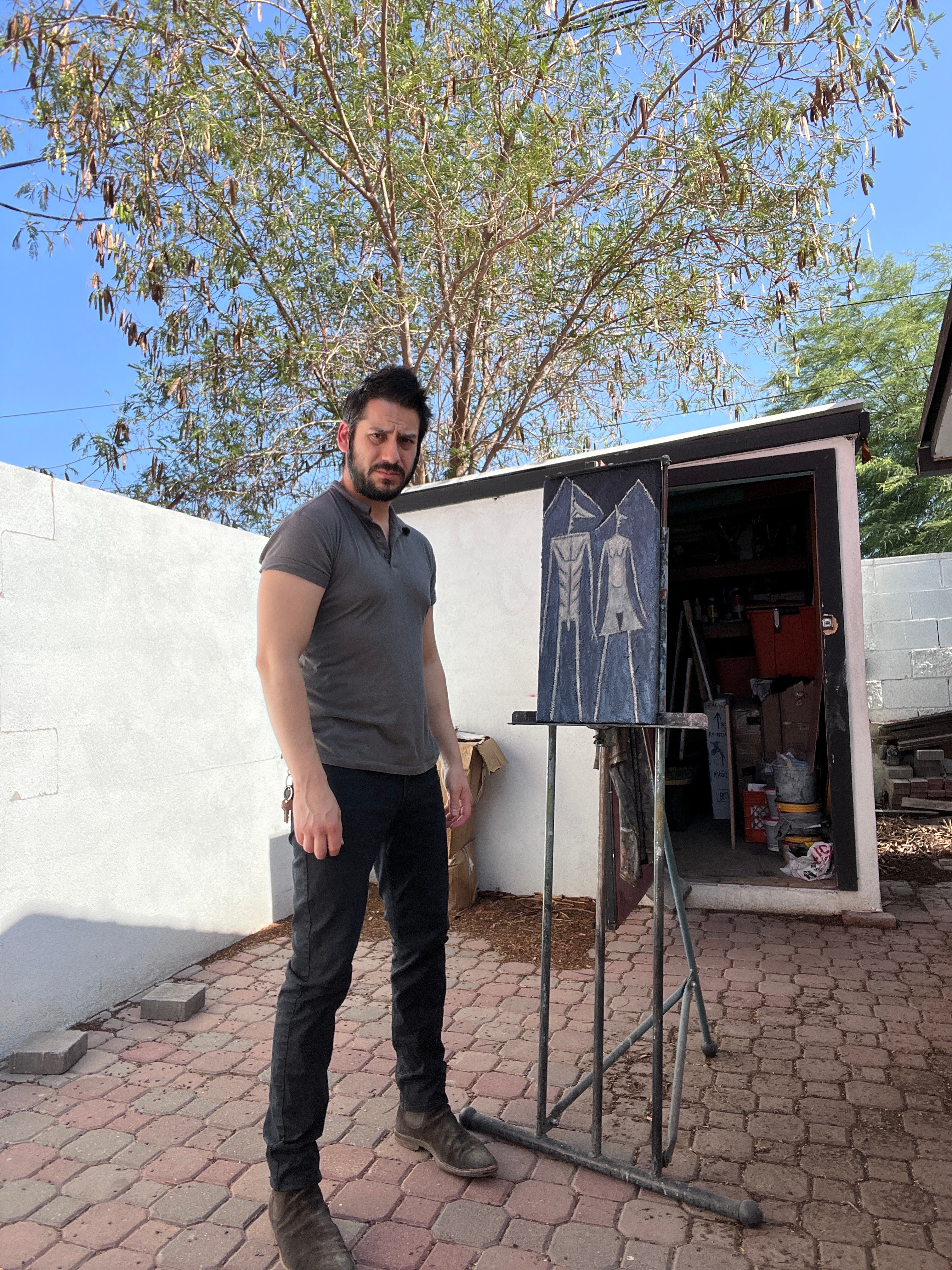
I usually have a few paintings I’m working on, so I take a look at them with new eyes.
Most everyday consists of painting or working on something art-related. I also work out 2-3 times a week. I try to ensure I eat well and dedicate some time to self-learning and improvement.
My girlfriend and I are regulars at many downtown spots.
Can you briefly introduce yourself and share what makes you or your brand unique?
Despite the stereotype of artists as narcissists, I don’t like writing about myself or my work. Maybe back ten years ago. I’ve done it so many times now, specifically for my CV and for open calls for shows, etc… My work tells my story and what I’m about. I don’t need words. I’m very prolific, and so there’s a constant link between myself evolving as a human and an artist.
My brand? I go by “BEV”. I don’t think of myself as a brand or business, though. I probably should, considering the times. Everything is for sale. I don’t make paintings for the sole purpose of being sold. I paint what I want and what I want to see.
I am not unique. And if I am, that’s for the world to decide after I die. Hopefully, it doesn’t take that long. Regardless, I’m not worried.
Okay, so here’s a deep one: Who were you before the world told you who you had to be?
I’d like to rephrase this question by explaining who I might have been before I decided who I wanted to be. I refer to it as my “blackout” era, or even “automatic living” stage of life. I was floating in existence. I felt no real sense of purpose or belonging. I was living in the small town of Yuma, AZ. Largely a religious town, and so my upbringing was very traditional Mexican Catholic shit.
As far back as I can remember, I never liked religion. I thought it was nonsense. I had an early “near-death” experience. I was ten years old, if I recall. I swallowed shampoo while showering — like a shot of shampoo. I felt like I couldn’t breathe and that I was going to die from suffocation by bubbles. I remember thinking, “This is it, I’m dead”. There was no solace in thinking about heaven or whatever. In my mind, it was just nothing.
That helped solidify some things early on: Life is brief.
From there, I kept learning. Kept having near-death experiences. Kept adapting and rebuilding.
I think the world forces you to be something you’re not if you let it. Shit, I mean, for some people that works. They skate by in life and cool or bad shit happens to them. But I believe we shape ourselves, or else we go on living like some generic version of a human. Again, some people are into that. I’m not. There’s a quote by Hunter S. Thompson that really resonates with me: “It is not necessary to accept the choices handed down to you by life as you know it”. I first read that maybe 12 years back. Ever since, I’ve tried to live by it.
If I had let the world decide for itself regarding my self-creation, I’d probably still be in Yuma, attending church on Sundays, and praying that “good things” happen to me. Maybe. I don’t know. Doubtful of the religious part. All I know is what I chose and where I am now: Phoenix.
Mind you, I don’t have anything against smaller towns. But I don’t like Yuma, and I don’t like visiting. There is something to be said about small-town mentalities, and I think there’s a truth to that.
Going back to who I was before I told the world who I was? Shit, I don’t remember anymore. I was scared, and I was very curious about how the world worked. Now, I still have my fears, but I use them to fuel me. And I’m still very fascinated by how the world works.
Was there ever a time you almost gave up?
Damn, there’s some heavy questions in this interview. Ha.
Giving up? Almost regularly. I’ve suffered many setbacks throughout my life. There are times when the depression and ambivalence are too much to bear. But then I realize: there’s nothing to give up. What AM I to give up? Living? I decided a long time ago I’d stick around for my allotted time. So then, what is there to give up? Painting? How? I mean, I can’t NOT paint. It’s what I do. Same for music. People? I guess I could TRY to give up on people, but again, there’s really nothing to give up. They continue to exist, and I am forced to share this world with them. Thankfully, I have found some good ones.
It’s much like the story of Sisyphus, and Albert Camus’s concept of “imagining Sisyphus being happy”.
We must be stubborn in our resilience even when it seems futile and pointless. We must assign meaning to our lives.
Alright, so if you are open to it, let’s explore some philosophical questions that touch on your values and worldview. What are the biggest lies your industry tells itself?
My industry? I guess that would be the “art world” or the “music world”? Where do I start? Um, “talent is cheap,” “everyone is an artist,” we’re all “creatives,” which I have to say I abhor that term. There are people born with what can be defined as “natural talent,” but even they have to put in the time. The hours. The discipline. You get what you put in, and there’s nothing cheap about that. Plenty of people have creative sides to them, but that doesn’t make them an “artist”. Not in the way I live my life or commit to my work. It took me a long time to be able to call myself an “artist”. It’s not a title I throw around lightly.
I remember in my teens, I wasn’t a popular or social type. I went home and taught myself to play guitar. I ran to music, to art, to escape from the banalities of high school and its hierarchy of popularity. But that is how it is in reality. A giant f*cking popularity contest, and trend after trend. The world runs on “it’s who you know”.
People frown upon “gatekeeping,” but I believe that in some respects, it helps maintain a level of integrity.
Now we got mfs taping banana peels to walls, fully AI-powered art, and people making their fortunes being nothing more than instagram-worthy artists with no vision—all regurgitation. There’s a quote that gets thrown around a lot: “Good artists copy, great artists steal,” usually attributed to Picasso — but that’s debatable. Anyway, my point is: THEY GET IT WRONG. Simply stealing something is pure plagiarism. I’ve lost count of how many “Basquiat” copycats I’ve seen (every town and city has one).
It’s no secret that art is born from other art—that perpetual cycle of influence. But you can’t just steal something or someone’s idea or style and call it your own. You ALWAYS give credit. AND you make sure that whatever you’re borrowing, you’re adding to it. Ideally, you’re making it better.
Before we go, we’d love to hear your thoughts on some longer-run, legacy type questions. Are you doing what you were born to do—or what you were told to do?
Born. Absolutely. I sought out my truth and found it. I think it works that way. That answer isn’t always right in front of you. I mean, I’ve been drawing since I could hold a pencil. But the decision to make this my life’s work. The reason I stick around. That I had to fight hard to find.
Contact Info:
- Website: https://bryant-vazquez.bandcamp.com/
- Instagram: brygenevaz
- Soundcloud: https://soundcloud.com/bryant-vazquez


Image Credits
All images by BEV (Bryant Eugene Vazquez).