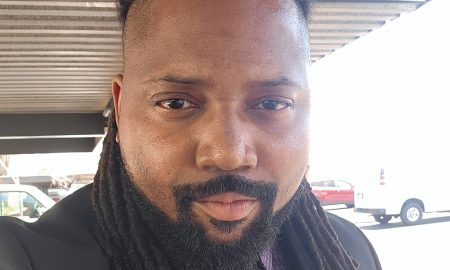
Today we’d like to introduce you to Tony Obr.
Every artist has a unique story. Can you briefly walk us through yours?
I think any creative impulse I have has its roots in my insatiable curiosity. I always have had (and still have to this day) a desire to know about everything around me. I can remember as a child wanting to discover what made the world tick, and I think I did this often times, by reverse engineering what others had made. That reverse engineering may have taken the form of taking apart and hacking old radios, transcribing jazz solos, and later in adolescence, hacking code that others had written.
I was lucky enough to have parents that supported my creative interests at a young age. My father worked in printing and painted as a hobby, and my mother came from a musical family. I began taking music lessons at a young age, with classical training on the saxophone and later other woodwinds such as clarinet and flute. I played in school jazz bands in high school, and I had the opportunity to sit in with a few local professional jazz ensembles also while I was in high school. Just before college I began exploring music and technology, and this was a game changer for me. The almost limitless creative possibilities of electronic music production excited me. Around this time, I also began exploring video production, digital art, and creative coding, and I saw parallels between the tools used in electronic music production and digital visual art. I took a bit of a long and winding path in college, trying my hand at a philosophy major as well as an English major, before eventually settling on art; specifically, digital art. Studying digital art allowed me to really explore this grey area between visual art and sound. And ultimately, I consider this grey area to be where I exist as an artist today; I am a visual artist and a musician who finds little difference between working in these two media.
With this background I’ve had the opportunity to work as an educator. I worked briefly as an art teacher for elementary and middle school aged children, and for the past 5 years I’ve been teaching electronic music classes at Paradise Valley Community College.
As a working artist I’ve been involved in composing music for dance, developing interactive installations for gallery spaces, composing music for film, designing album covers, and showing digitally rendered fine art prints in galleries.
I also compose music under a variety of artist names, releasing CDs on a variety record labels, and I frequently work in collaboration with other musicians.
Please tell us about your art.
My creative practice results in work that spans across (and intertwines) a number of different of media. Music composition, sound design, animation, visual design work, fine art prints, and developing interactive sound and lighting systems for dance; the fact that all of these disciplines for me require the use of machines might be the common thread that runs through them all. I could call myself a digital artist, but I feel that description would be a little inadequate. I do use software and computers to create much of my work, but I also use analog synthesizers, acoustic instruments such as piano and saxophone, and field recordings.
My work in sound, music, and visual art stems from an interest in the aesthetic revelation of complex systems. I tend to think of my work as revealing truth through patterns. Patterns observed in both the natural and constructed domains. Patterns of form, but also dynamically evolving patterns of movement and growth. Cloud formations, flocking behavior, rivulet movement, shell growth, as well as imagined cityscapes, urban design, and impossible architecture. My process begins with algorithmically generated digital renderings, or continually evolving, generative soundscapes.
When creating music, I normally begin by constructing complex web of interconnected sound making devices on an instrument called a modular synthesizer. Those who have seen me perform live have probably seen me using this instrument, which looks like a submarine control panel and a tangle of wires. I also create much of my music using custom built software that operates under principles similar to the modular synthesizer. Likewise, my visual art is primarily created using software that allows me to explore this expression of complex systems. I see my visual art and my music as coming from the same place. The design problems I try to solve, the themes that I explore in my work, they all begin with the same impetus. It’s really just a matter of preference in that moment has to which tools I choose to use when approaching a work for the first time.
I often think of the machines I use to create my work as collaborators. I develop these complex systems, and then relinquish some of my creative agency to the machines. This brings in an element of surprise for me, since I’m never fully aware of what will result when the system is set in motion. One way to think of this process is that it’s a really complex Rube Goldberg machine. You can spend hours setting up the system, but when you finally let it run, when you knock over that first domino, the resulting chain of events could very well be not that satisfying. So, you set up the complex machine again, but you change one variable to see if the new iteration is any better. This process (systems building, testing the system, making changes to achieve better results) can happen at a fast pace, or it can take hours to fine tune. Ultimately this process is one of curating decisions, and I don’t think it’s that far removed from how artists work in more “traditional” media.
Choosing a creative or artistic path comes with many financial challenges. Any advice for those struggling to focus on their artwork due to financial concerns?
The best advice I can give to someone facing financial challenges as an artist (and to be honest, what artist isn’t going through that particular struggle) is to have patience and to never give up. I know that sounds really cliché, but there’s truth to it. There might be a huge disconnect between where you are right now in your work and where you want to be. Maybe your technique isn’t quite there yet. Or maybe you have a strong body of work but nothing is selling. The key is to not get discouraged and maintain that connection to why you’re making art in the first place. Probably, for most people, the reason they’re making art has nothing to do with making millions.
The reason they make art is that it nourishes them on some level. It satisfies a need in us that can’t be met by any other means (I’ve always thought of getting paid for my work as icing on an already very tasty cake). So just keep working on your art. Everyday. Go into your studio, or quiet place, or wherever you make art, and work, even if you don’t feel like it. The masterpieces that inspire you really came about from 99% perspiration. If you put in the work eventually you’ll find your audience, and you’ll probably start to see financial rewards for all this hard work. It might take a year, it might take 10 years (more advice: everyone follows a different path, and it’s pointless to compare your path to the paths of others), the point is to just persevere, and through that perseverance there’s a good chance you can make money doing what you love.
How or where can people see your work? How can people support your work?
My website is the central hub for most of my work (tonyobr.net). There you can find a list of all my past work as well as current work and upcoming events. You can also purchase prints from my website. Also, one of the best ways to support my music is by purchasing it through my bandcamp page: tsone.bandcamp.com
Contact Info:
- Website: tonyobr.net
- Email: tsonesound@gmail.com
- Instagram: https://www.instagram.com/tonyobr/
- Facebook: https://www.facebook.com/anthony.obr
- Other: https://tsone.bandcamp.com/


 Image Credit:
Tony Obr
Getting in touch: VoyagePhoenix is built on recommendations from the community; it’s how we uncover hidden gems, so if you know someone who deserves recognition please let us know here.
Popular
-

Phoenix’s Most Inspiring Stories
-

Building Love With Purpose: Darryl & DeLonda Tucker on Faith, Resilience, and Expansion
-

Andrea Savarese Is Redefining Veterinary Care Through Calm, Connection, and Compassion
-

Sun Cities 4 Paws Rescue Is Building a Sustainable, Compassion‑First Future for Feline Welfare