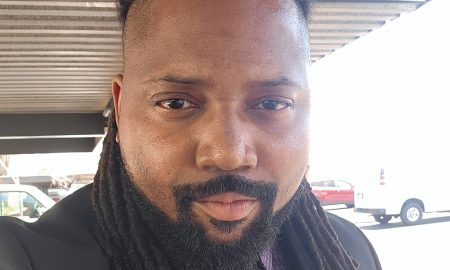
Today we’d like to introduce you to Ryan Wells.
Ryan, let’s start with your story. We’d love to hear how you got started and how the journey has been so far.
As a kid from Phoenix in the 80’s, I was definitely caught up in the ‘Ninja Craze;’ but my interests started even before that. I have really been interested in Japanese culture and martial arts all my life. In elementary school, while other kids were mostly interested in playing video games, I would walk to the library by myself (which we could do in those days) and consumed any material I could find about East Asia. I had my share of comic books, but I enjoyed reading about cultures that seemed far-off and exotic more.
In the 6th grade, I was reading Musashi’s Book of Five Rings and The Analects by Confucius, rather than Batman, for example. Unfortunately, my parents and the rest of my family didn’t quite understand me at that point. My mother thought it was a fad I was going through and she always thought I would outgrow it. Because of that, she never wanted to give in and let me study martial arts.
I ended up channeling my energies in other ways throughout high school. I was very competitive with track and cross-country, so I used to work out like crazy and run for hours. This level of fitness allowed me to run later on in college and it also helped me when I eventually began studying martial arts. In college, in the early 90’s, I began studying Japanese and soon received my Associate’s Degree in the language.
Simultaneously, I began studying several martial arts, including Chinese, Japanese, Korean, and Filipino arts. I eventually began to focus in on just the Japanese arts. In 2000, I joined the Air Force. I was initially stationed at Vandenberg AFB in California. While there, I joined the local judo club. It was a great experience and it utilized many of the skills I had been developing through my other training. In 2002, I was stationed at Yokota Air Base in Japan. There, I met the woman who would eventually become my wife.
During this time, I again found myself training in traditional Japanese arts and was very lucky to train with high-level masters. However, those years were challenging, because of deployments and the combat operations in the Middle East. My fiancé and I decided to move back to the U.S. and get married in Arizona. In 2005, we were married by Rev. Sugiyama of the local Arizona Buddhist Temple.
For the next few years, I taught Japanese martial arts while returning to college to complete my degree. I also began studying a couple other martial arts. My wife and I longed to move back to Japan though. So, in 2010, I had the opportunity. I was selected to teach English in Kyoto for the Japan Exchange and Teaching (JET) Program. While living in Kyoto, I had many, many unique cultural opportunities. These opportunities included being able to train with several martial arts masters from different traditional disciplines. Even after more than 20 years of studying martial arts, I continued to learn many new and interesting things.
In 2011, there were some big things that happened to us in Japan. First of all, my father-in-law passed away in Tokyo. That was very difficult for everyone. He was such a kind person and he always looked out for everyone. My wife decided to stay with her mother to take care of her for a little while after the funeral. About two weeks after he passed, while my wife was still in Tokyo looking after her mother, the 2011 earthquake and tsunami happened that devastated many parts of northern Japan. My wife and family were fine but shaken up. Fortunately, there were very few injuries in Tokyo. However, there were radiation concerns and power blackouts and brownouts for about the next year.
In late March, my wife returned to Kyoto. A few months later, on June 30th, my daughter was born. That was the bright spot in an otherwise very challenging year.
In late 2012 and early 2013, I faced different challenges. I got extremely sick and the doctors were unable to pinpoint the issue. At one point, I was taking about 12 different prescription medications simultaneously. I was so sick that I thought I was going to die. I decided the only way to recover was to come back to the U.S. In summer 2013, we returned to Arizona. My health slowly recovered and I eventually was able to start teaching small martial arts classes again. Because the arts I practice are very traditional and obscure, I did not find much success in gathering students.
Therefore, I decided to limit my teaching to semi-private group lessons. Nevertheless, I continued to consider ways to promote Japanese culture and martial arts in the valley. I began to discuss my idea for a Budokan in Phoenix with anyone who would listen. They encouraged me to continue to pursue the idea. After a few years, I finally decided to make the project official. I started a nonprofit in January 2017 to work to establish the Budokan.
I continue to teach several Japanese martial arts in the valley, including Hoten Ryu, Meifu Shinkage Ryu, and Bujinkan Budo Taijutsu. I also continue to be involved in the JET Program in Arizona with yearly information and interview sessions. My real dream though is to see a Budokan come to fruition in Arizona.
Arizona has been the home to some real pioneers in Japanese martial arts. I am doing my best to continue their legacy. I am one of only a handful of Meifu Shinkage Ryu practitioners across the U.S. and the only one teaching in AZ. Furthermore, I am the only person outside of Japan teaching Hoten Ryu. I think having these rare experiences puts me in a unique position to help spread Japanese martial arts in the U.S. and to understand the need for a local Budokan.
Has it been a smooth road?
The biggest obstacle has been getting people to support a project that will undoubtedly be years in the making. I liken it to the reluctance for decades to invest in public transportation in the valley. I understand that most people find it difficult to invest in something that won’t provide immediate gratification. However, it is my job to change minds. When people say there isn’t any culture in the valley and there aren’t many interesting, family-friendly places to go, I ask them what they have done to change the status quo.
The second obstacle I have experienced is getting people to realize Arizona has a deep history that includes Japanese culture. Going back to the internment of Japanese-Americans in Arizona during WWII up through the various Japanese cultural celebrations held in the modern day, there is much to consider. Have you heard of the Japanese flower gardens that used to exist in South Phoenix from the 1950’s to the 1980’s? How about the Matsuri festival held in downtown Phoenix each year?
Did you know it is already in its 34th year? It is estimated that 70,000 people showed up for the festival in 2017, making it one of the largest in the U.S. Have you heard about the local Japanese school called the Arizona Gakuen? It has been in existence for close to 30 years! So, don’t discount Japanese culture in Arizona. It may not be as obvious as it is in Seattle, San Francisco, or Hawaii, but it is still rich and vibrant.
So, as you know, we’re impressed with Phoenix Budokan and Japanese Cultural Center – tell our readers more, for example what you’re most proud of as a company and what sets you apart from others.
I taught martial arts for several years before moving back to Japan. I was often frustrated by the lack of public facilities to practice or to host seminars in Arizona. When I returned to Japan, I began to develop an idea. In Japan, major cities often have their own Budokan buildings. A Budokan can be thought of as a community facility for the study of traditional and modern Japanese martial arts. Generally, Budokan contains large open spaces for the practice and competition of these martial arts.
I often trained in Budokan throughout the time I lived in Japan (in Kyoto, Nara, Osaka, and Chiba prefectures) as well as on my many visits. I thought at that time, a Budokan would be great for Arizona. When I moved back to Phoenix, I mentioned my idea to several local martial artists. They agreed it was needed and encouraged me to pursue the idea. After realizing that several other local Japanese cultural groups were struggling to find permanent homes to practice and perform, I decided to expand the scope of my plans.
Over the past several years, I have refined my plans as I’ve gained input from martial artists and those in the Japanese/Japanese-American community. Through those conversations, I decided to spearhead an effort to build a nonprofit, multipurpose Japanese cultural center in the valley, with an open gym capable of serving as a Budokan. The Budokan will have classrooms, a library, and exhibits, with the capability to host large, cultural performances and seminars.
Let’s touch on your thoughts about our city – what do you like the most and least?
I love that Phoenix is still young and capable of determining its future. We continue to grow and thrive, so that makes our future bright. However, the thing I like least about the city is that there is often an attitude of apathy towards planning. My project is looking to buck that trend.
Contact Info:
- Website: phoenixbudokan.org
- Facebook: https://www.facebook.com/phoenixbudokan/
- Other: https://entendojo.weebly.com/


Getting in touch: VoyagePhoenix is built on recommendations from the community; it’s how we uncover hidden gems, so if you know someone who deserves recognition please let us know here.
Popular
-

Phoenix’s Most Inspiring Stories
-

Building Love With Purpose: Darryl & DeLonda Tucker on Faith, Resilience, and Expansion
-

Andrea Savarese Is Redefining Veterinary Care Through Calm, Connection, and Compassion
-

Sun Cities 4 Paws Rescue Is Building a Sustainable, Compassion‑First Future for Feline Welfare