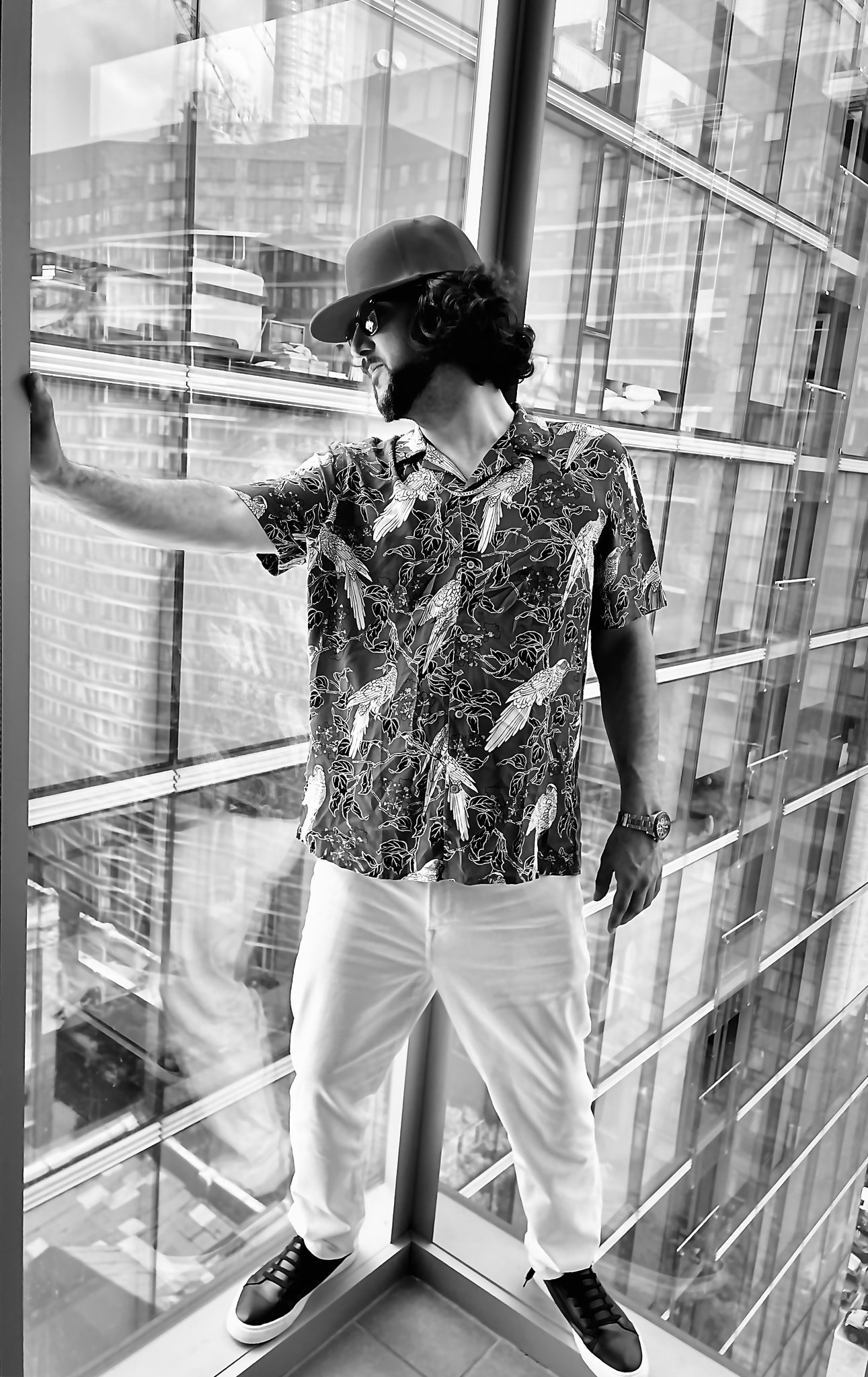
Today we’d like to introduce you to Mario Albert.
Hi Mario , we’d love for you to start by introducing yourself.
My journey really starts in the Bay Area, where I grew up in the 90s. It was an incredible place and time to come of age, but it also had its pitfalls. My generation experienced watching enormous cultural and technological changes happen right in front of us. The Bay Area was becoming one of the centers of the new economy, but at street level there was another reality. There were friends who succeeded, friends who struggled, and homies who never made it to adulthood. You learned early that opportunity and tragedy could exist only a few blocks apart.
Those experiences shaped the way I look at success. I never saw life as a perfectly mapped-out path where you go to school, get a job, buy a house, and everything simply works out. For a lot of people in my generation, life didn’t unfold that neatly.
Then came September 11, 2001. Like millions of Americans, I watched the world change almost overnight. It was one of those moments where there was clearly a “before” and an “after.” The wars that followed, economic uncertainty, and eventually the 2008 financial crisis reinforced something I had already learned growing up: stability can disappear much faster than people imagine.
And there almost seems to be a rhythm to it. Every decade, our generation has encountered another major disruption. We came through the turbulence of the 1980s and 1990s, 9/11 and the wars of the 2000s, the Great Recession and its aftermath, and then COVID-19 in 2020. Technology simultaneously transformed how we work, communicate, build businesses, and even understand the world around us. Each era seemed to rewrite the rules just as we were getting comfortable with the previous ones.
That history taught me adaptation.
I’ve spent more than a decade working across different industries, building businesses, recruiting and developing people, and learning firsthand what it takes to start over when circumstances change. Entrepreneurship became a natural extension of that mindset. I’m constantly looking at systems and asking, “Why does it have to work this way, and what could we build instead?”
Over the years, that curiosity has led me into business, staffing, technology, media, and other ventures. I’ve had successes, failures, unexpected turns, and ideas that had to be completely rebuilt. I’ve also relocated and gone through personal and professional challenges that forced me to reconsider what success actually means.
Today, we are based in Las Vegas, Nevada and Phoenix, Arizona while continuing to build toward a much larger vision. At this stage of my life, success isn’t simply about making money. It’s about building something sustainable, creating opportunities for other people, taking care of family, and leaving behind something that has value beyond my own lifetime.
When I look back at the Bay Area kid from the ’90s and compare him with who I am today, the connecting thread is resilience. My generation has watched the world reinvent itself several times. I’ve learned that you can’t spend your life waiting for the world to become predictable.
You learn the new rules. You adapt. And then you keep Succeeding.
We all face challenges, but looking back would you describe it as a relatively smooth road?
It definitely has not been a smooth road. I’ve experienced business setbacks, financial difficulties, relationships that didn’t work out, family challenges, legal battles, career changes, relocations, and periods where I’ve essentially had to rebuild from the ground up.
One of the biggest lessons I’ve learned is that hard work doesn’t guarantee a straight-line outcome. You can make what you believe are the right decisions and still encounter circumstances completely outside your control. You can build something and lose it. You can trust people and discover that trust was misplaced. You can have a plan that makes perfect sense and wake up one morning to find that life has rewritten it for you.
I’ve also experienced the reality of entrepreneurship. There are periods when you’re doing well and everything seems to be moving in the right direction, followed by periods where you’re trying to figure out how to keep everything together. I’ve pursued opportunities that worked, others that failed, and some that taught me more from failing than I probably would have learned if they had succeeded.
There have been moments when I’ve had to put pride aside and simply do what was necessary. Sometimes that meant starting another business. Sometimes it meant taking a regular job, rebuilding financially, and creating stability while continuing to work toward the larger vision. I don’t believe there’s anything wrong with taking a few steps sideways, or even backward, if you’re positioning yourself to move forward again.
I’ve dealt with loss as well. Losing people, relationships, opportunities, money, and time changes your perspective. Eventually you realize that rebuilding isn’t something that happens once in life. For some of us, rebuilding becomes part of the journey.
That’s probably the biggest thing my struggles have taught me: how to rebuild.
I’ve become much less afraid of starting over because I’ve done it before. When something falls apart, my first question eventually becomes, “What do I still have to work with?” From there, you start putting the pieces together again.
Those experiences have also changed my definition of success. When I was younger, success was much more connected to money, accomplishments, and reaching a certain destination. Today, I think about ownership, stability, family, freedom, creating opportunities for other people, and building something that can continue beyond me.
So no, it hasn’t been a smooth road. There have been potholes, detours, road closures, and a few stretches where somebody apparently stole the road entirely.
But I wouldn’t separate those struggles from the story. They’re part of what taught me to adapt, think independently, and keep building even when the original blueprint no longer exists.
As you know, we’re big fans of you and your work. For our readers who might not be as familiar what can you tell them about what you do?
Today, my work is centered around building an ecosystem of businesses rather than just one company. The major pieces of that are staffing and recruiting, XYZ Entertainment, and Gazillion.
Staffing has been a significant part of my professional life for more than a decade. I’ve recruited across different industries and learned that successful recruiting is ultimately about understanding people. Salary, location, opportunity, and availability all matter, but so does recognizing someone’s potential and connecting them with an opportunity that can genuinely change their trajectory.
XYZ Entertainment represents the creative side of what we’re building, bringing together entertainment, media, talent, culture, and intellectual property. Gazillion represents the larger vision: building businesses across different industries that can eventually support and strengthen one another. I don’t necessarily believe in staying in one lane. Some of the most interesting opportunities appear when you figure out how different lanes can intersect.
But when I’m asked what I’m **most proud of**, it actually isn’t a company or a business accomplishment. It’s my family.
Success means much less to me if it only benefits me. As I’ve gotten older, I’ve become increasingly focused on what I can build for my family, what I can leave behind, and how whatever success I achieve can be used to help other families as well.
That’s also why **Fathers for Lost Sons and Daughters of America**, my nonprofit, is so important to me. It’s deeply personal. The organization is focused on fathers and families dealing with separation from their children and the difficult circumstances that can surround those situations. I want to use the resources, relationships, platform, and experience I’ve gained through business to help grow that mission and create something capable of making a real difference in people’s lives.
In many ways, that’s where everything I’m building ultimately connects. I want the success of our businesses to create the resources to do more than simply generate profit. I want it to help create jobs and opportunities, strengthen families, support people who feel like they don’t have a voice, and give the nonprofit the ability to reach more fathers, sons, daughters, and families.
What sets me apart is probably that I don’t see business, family, and community as separate worlds. To me, they’re connected. Business creates resources. Resources create independence. Independence gives you the ability to help other people.
So when I think about legacy, I’m not particularly interested in being remembered simply for building a successful company. I’d rather be remembered as a father who built something meaningful for his family and then used his success to reach back and help other families.
If Gazillion becomes everything I believe it can become, one of its greatest accomplishments won’t be how much it earns. It will be how much we’re able to do with what we build.
Can you talk to us a bit about the role of luck?
I think luck has played a role, but **perseverance is a better word for my story**.
I’ve experienced both sides of luck. I’ve had opportunities come at the right moment, met people who opened doors, and made decisions that turned out better than I could have predicted. I’ve also experienced losses and setbacks that no amount of planning could have prevented.
What I’ve learned is that neither good nor bad luck lasts forever. That’s why I try not to build my life around either one.
For me, the real advantage has been staying in the game. When something hasn’t worked, I’ve adjusted. When circumstances changed, I found another direction. Sometimes that meant rebuilding a business, changing industries, taking a job, moving somewhere new, or simply accepting that the next chapter wasn’t going to look like the one I originally planned.
I think perseverance creates its own kind of luck because the longer you remain engaged, curious, and willing to work, the more opportunities you give yourself to encounter the right moment.
At this point in my life, I’m proud that after everything I’ve experienced, **I’m still standing**. I’m still a father, still an entrepreneur, still building, and still thinking about what’s next.
Luck may influence the circumstances. Perseverance determines whether you’re still there when the circumstances change.
Contact Info:
- Website: https://www.gazillionusa.com