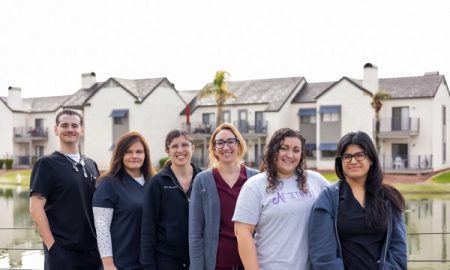
Today we’d like to introduce you to Jenifer Tull-Gauger and Kirk Gauger.
This husband-and-wife team of karate instructors started as high school sweethearts in Southern California. They met in art class in their sophomore year and started dating junior year.
They later moved to Arizona because jobs were plentiful there. Arizona has been good to them for the last 20-plus years. They love the people, the clean air and the weather (most of the year). They were still fairly new to the area in the spring of 1999.
That was when Kirk told Jenifer that he wanted to give her karate for her birthday, “Find a place and we’ll try it out together. That will be your present.” Kirk insisted that out of all the martial arts options, he was only interested in karate for him and his wife, “Because you don’t mess around. You disable the attacker and you stop the attack.” Until then, they had been only mildly interested in martial arts. Over the years, when they would see a karate movie, or pass by a dojo, they would say, “We should try that one day.”
That day came in ’99 and they loved it from day one. The teacher, Newland Sensei, has such positivity, enthusiasm and passion for karate. That was contagious. They enjoyed working out while usually not really thinking about it because they were learning Japanese and martial arts culture, as well as self-defense and having fun while doing it. Kirk and Jenifer flourished on a fast track through the ranks with support and encouragement from the senior students and instructors.
In 2002, they earned their first black belts and toward the end of the year, Newland Sensei handed the program over to them. He was trying to balance his life with other pursuits, including a new marriage.
“It was a struggle, jumping in to teaching and heading a dojo. But it has been so worth it, for us as a family, and for each of us as individuals. We have been constantly learning and honing our craft, both in the physical martial arts skills, as well as our skills in owning a business and decision-making. Our business is about people, so we have sharpened our interpersonal abilities. We are so blessed to have so many great, supportive students and their family members involved in our dojo,” says Jenifer.
Great, so let’s dig a little deeper into the story – has it been an easy path overall and if not, what were the challenges you’ve had to overcome?
Most of our challenges have been financial. We jumped in and made financial commitments, with the thought that you have to spend money to make money. That didn’t work for us. We went out on a limb with hopes and dreams of how fast we would grow. When the economy took a downturn, it trickled down to us over the years, and our student base diminished.
But we persevered. The moral support of our instructor in Missouri, Allan Amor Kaicho, and other dojo owners in the United Ryukyu Kempo Alliance have kept us going. Plus, the long-term students here who make the backbone of our school have been instrumental in re-growing the dojo to where it is today.
It’s amazing how powerful a positive attitude is. When we were focused on the low participation and the expenses that we struggled with, things either got worse or stayed stagnant. But we had a big dojo meeting where we laid it all on the table and said “We need your support.” Then we focused on staying positive: about growing the dojo; about committing to its best necessities; and about working together as a larger team, for the benefit of all involved. Almost immediately things started working out for us.
And that’s not to say that now we just sit back and watch the new students roll in. We continue to focus every week, every day on the positive growth of the dojo, of our students and of ourselves personally. If there’s one thing karate has taught us, it’s that if you want something, you must work for it consistently. And continue to put positive effort into cultivating it.
Please tell us about East Valley Martial Arts.
We are known in the local community for being family-friendly, for supporting and growing contributing members of society, and for teaching traditional Okinawan karate. Parents of our students appreciate our caring professionalism and communication. We specialize in the style of Ryukyu Kempo with roots in Shorin Ryu.
We are known in the international United Ryukyu Kempo Alliance as a dojo with a strong, well-established, long-term kids program. And also for our whole-family involvement, as well as our open communication with students and their families.
We are most proud that we are authentic. We legitimately teach the life protection arts. It’s not sport karate. We practice a true life protection art, and not just in the physical sense. But in understanding the preciousness of life and the need to protect it. Our life protection skills have been time-tested, tried and proven, and we consistently work on building the habits to acquire, ingrain and master these skills.
What sets us apart from other schools is our traditionalism. We bring in the cultural traditions and the ceremonies of respect of the martial arts from Okinawa. We carry on the tradition of life protection arts that have been passed down from teacher to student for hundreds of years. What sets us apart from other organizations where people might spend their time (sports, clubs, classes, meet-ups, even other martial arts schools) is that we protect, promote and teach the traditional values of the Dojo Kun. These teachings are the heart of all that we do, and we take them very seriously. The Dojo Kun was created by Shungo “Tode” Sakagawa, so that his students would have something to practice and work on that would help with self-improvement. The Dojo Kun values are: 1) Strive for a good moral character. 2) Keep an honest and sincere way. 3) Cultivate perseverance or a will for striving. 4) Develop a respectful attitude. And 5) restrain my physical abilities through spiritual attainment.
Do you look back particularly fondly on any memories from childhood?
My first martial arts experience was extremely positive, and like a root that would eventually grow to something big when I became a young adult. When I was about eight, I participated in one round of aikido classes at a rec center, and really enjoyed it. What I remember most is learning to do forward rolls and each of us students taking turns executing them. And also sitting in a circle while the teacher checked in with each of us. He called me Genevieve and gave several of us nicknames. He built a rapport with us in a relatively short amount of time. -Jenifer
Pricing:
- (Little Dragons) three-to-five-year-olds have two classes per week
- (Kids) ages six to twelve can attend two or three classes per week
- (Adults) age 13 and up get unlimited classes
- Tuition is $1,290/year to $150/month
- Tuition includes the whole curriculum a student could need or hope for, meaning we don’t up-sell to more expensive programs once students are hooked
- Groundfighting is an optional class, for which students need to have basic standing techniques and instructor approval
- Weapons classes are offered with instructor approval, after a student shows proficiency, maturity and ability to follow proper etiquette
- No-Obligation Introductory Program is $30 for your first week of classes and includes a free uniform
Contact Info:
- Address: 1829 South Horne, Suite 8
Mesa, AZ 85204 - Website: http://www.EVMA.net
- Phone: (480) 892-4240
- Email: info@evma.net
- Instagram: https://www.instagram.com/eastvalleymartialarts/
- Facebook: https://www.facebook.com/EastValleyMartialArts
- Twitter: https://twitter.com/EVMADojo
- Yelp: http://yelp.com/biz/east-valley-martial-arts-mesa
- Other: https://www.tumblr.com/blog/eastvalleymartialarts


Image Credit:
Brenda Rhoad, Amy Wray, Alejandro Lopez, and Kane Photography
Getting in touch: VoyagePhoenix is built on recommendations from the community; it’s how we uncover hidden gems, so if you know someone who deserves recognition please let us know here.
Popular
-

Phoenix’s Most Inspiring Stories
-

Building Love With Purpose: Darryl & DeLonda Tucker on Faith, Resilience, and Expansion
-

Andrea Savarese Is Redefining Veterinary Care Through Calm, Connection, and Compassion
-

Sun Cities 4 Paws Rescue Is Building a Sustainable, Compassion‑First Future for Feline Welfare