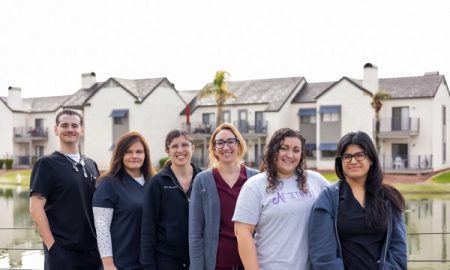
Today we’d like to introduce you to Debbie Kail.
So, before we jump into specific questions about your organization, why don’t you give us some details about you and your story.
I grew up outside of Boston, loving the seasons! I always pushed myself to try new things and I loved exploring, which is how I ended up going to Emory University in Atlanta, GA, when there is no shortage of amazing higher ed opportunities in the Boston area! I loved college – yes, I loved learning but I loved having internships and being involved throughout campus. I used to joke with my friends that my real major was my extracurricular activities – helping to run a literacy program in local schools and serving in leadership in my sorority.
When I was a student at Emory, I somehow met someone who worked at the Hillel there. She took me to lunch sometimes and we got to know each other. While I did go to Shabbat services occasionally, I only went if a friend was free. We didn’t really feel a part of the community aside from our friendship with this Hillel staff member. My involvement in Hillel was more about my personal interests; I served as a representative from my sorority to a Jewish Greek Council, I took a Kabbalah class with the campus rabbi, and I went on the Birthright Israel trip with a few friends from my sorority. I was a senior during 9/11. I lived a plane ride away from college, and my world changed. Having these connections and experiences gave me a place to go to start processing what had happened. I remember not feeling like I could explain how I felt, just knowing I needed to be in a Jewish space.
I love telling the story about how I got my first Hillel job. My best friend and I were at the campus mailboxes and we both got letters from a Hillel staff member at the University of Georgia. The letter explained that there was a special Hillel fellowship for graduating seniors to work at a Hillel for 1-2 years, trying to help uninvolved students connect to Jewish life based on their pre-existing communities and interests. My friend threw her letter away and I called the Hillel program director to get more info! (Don’t worry, we are still best friends today!) She encouraged me to apply and through that process, I understood that my interest and experience in customizing my Jewish involvement had given me the basic tools to help others do the same. Plus, I realized that I could use my Psychology major and Religion minor in my job.
I will admit that when I took that first job, it seemed more like a fun thing to do after college than the start of a career. I had amazing mentors at Hillel at Washington University in St. Louis (formerly St. Louis Hillel), staff at the Hillel as well as student affairs administrators and board members who really listened to me and helped me see that working in student affairs and Hillel could be a career. I remember the Vice President of Student Affairs at Wash U took me to lunch at the nice faculty restaurant. It felt like such a big deal – I was probably 22 or 23 and this woman was spending a whole meal with me! I went on to pursue a graduate degree in student affairs; and I only learned that this was a possible path through some amazing mentors.
I continued to feel invested in by mentors and professors in grad school and by Hillel International, which has given me grad school scholarships and almost unlimited professional development opportunities during my 15 years with the organization. One program was a Hillel International’s Weinberg Accelerate Executive Training Program, and that helped with the transition from being a #2 at a large Hillel to taking over here at ASU Hillel in 2013. I continued to receive support from Hillel International and the local Jewish community as we focused on innovative and collaborative strategies to building a strong Jewish experience for ASU students.
I have a front-row seat and a guest role in the future of American Judaism! In working with students and with my staff, I am constantly learning about the changing needs of young adults and how Judaism remains relevant. There is a lot in the media that can cause us to worry- about challenges on campus, about apathy amongst young adults, about the disappearing Jewish community, anti-Semitism and lack of civil discource. And yet from where I sit, the future is bright and filled with amazing, passionate people who may be Jewish in different or non-traditional ways, but who will shape the future of what it means to be Jewish in America.
Plus, you can’t beat the variety in my job. In an average day, I can support a staff member, mentor a student, order supplies, review a budget report, plan for a board meeting, and engage with a supporter of our work. I love how Hillel work stretches us all to use a variety of skill sets each day.
Has it been a smooth road?
When I take a step back, it is easy to gloss over some challenges and feel so proud of what we have all accomplished. But no, I wouldn’t say it has been smooth. When I started, we only had one month of cash in the bank. I lost sleep over payroll on and off for about two years until we were able to stabilize our funding. I have been fortunate to receive support and training through the Life and Legacy program on building an endowment, so we have been working on that, but like most nonprofits, we start each July 1 back at $0 and have to fundraise. Our budget has grown from about $330,000 when I started to close to $1M. Our success brings bigger opportunities and bigger challenges!
On the personal side, I was building my family the whole time I was building this organization. I have now been fairly public with my struggles with infertility, but for the early years of my time here, I was suffering privately while always trying to put on a happy face. I was fortunate to find a wonderful support group and good doctors, but the trauma of infertility and miscarriage will always be with me in some way. I decided to start sharing my story and getting involved with Fruitful, a Phoenix-based support group for those navigating the challenges of infertility, so that I could help others feel less alone than I did.
As we went through the journey of building our family and my organization, everything felt intertwined. From giving myself hormone injections in the bathroom of my board president’s office to having my first child on the first day of classes at ASU and having my second child on the day we were hosting a grant officer for a site visit for the largest grant we had ever applied for (we got it!).
From these challenges, the biggest lessons I have learned are (1) listen to yourself and your body – if you need a break, if you need to push yourself, whatever it is, trust what your gut is telling you. anything else will cause your stress to build up in potentially unhealthy ways; (2) surround yourself with a strong team – I have been able to rely on staff, mentors, board members, friends and family. I have no interest in succeeding on my own! Success for me is about building the right team so we can support each other and our goals; (3) Work/Life balance is an endless pursuit and doesn’t mean that every day is perfectly balanced. That shouldn’t be our goal either. Our goal should be to make the difference we can that day and play the long game.
COVID has really highlighted these lessons for me. Of course the challenge of COVID, pivoting our organization, applying for a PPP loan, figuring out how to build community when we can’t open our center or be in person like we are used to. These are things that could really bring someone down. Or, they can inspire someone to rethink everything, in the best ways possible. Every so often I fall in the former, but for the most part I’m in the latter, waking up each day excited about the possibilities we have to try new things that we wouldn’t have even thought of before.
We’d love to hear more about your organization.
ASU Hillel’s mission is to enrich the lives of Jewish undergraduate and graduate students so they may enrich the Jewish people, Israel, and the world. We envision a world in which every Jewish student will make an enduring commitment to Jewish life. From leadership development to professional mentoring, religious, cultural, and Israel education initiatives, ASU Hillel has something for everyone! We proudly celebrate diversity and welcome students from all backgrounds. We aim to be students’ one-stop-shop for their core needs of connections, community, and career preparation.
In 2011, Hillel International and the Jewish Federation of Greater Phoenix started working together to help ASU Hillel consider how to meet the needs of the large number of students that ASU was now attracting. At the time, we were engaging under 100 students in a deep way and taking 10-15 students on Birthright each year. We worked with students and supporters to revise our strategies and initiatives, and to grow our staff and budget.
We now reach over 700 students/year and continue to grow. We have been a pilot campus of several Hillel International initiatives including a measurement program now scaled to over 100 Hillels and an early-career professional fellowship. We now proudly support a robust student leadership program, an engagement intern program, classes about Israel, leadership and Jewish learning, and trips to Israel for 80-100 students/year. Many local and national funding partners have recognized our work with new grants, and our budget has grown every year. Our growth prompted us to seek additional space and when the property next door to ours became available, we were able to raise $1.25M in three short months to purchase the building without a mortgage. We are working to integrate the two buildings so that we can create a campus for Jewish life at ASU.
We are known for our focus on individualized experience in a community setting. Staff and student leaders make an effort to get to know everyone and to find the right event or experience for you. This is not a cookie-cutter organization where we try to plug people in. COVID has further reinforced that and helped us solicit ongoing input as we evolve. We are also known for our outstanding student leadership opportunities that not only give students resources and training to build a community for their peers now but give students real experience to train them for future leadership and volunteer opportunities upon graduation. We are also known for our warm, welcoming, pluralistic environment. Students of all backgrounds are not just welcome but embraced. Jewish students who grew up barely knowing they were Jewish can become friends with Jewish students who celebrated Shabbat every week. Non-Jewish students are an important part of our community as well and are equally welcome.
Is our city a good place to do what you do?
This is a little hard to answer for Hillel specifically, since we are a college-based organization. I think any place that has colleges and universities is a good place for a Hillel! More broadly, We do welcome students from local community colleges too, by the way, and hope to have more resources to do more outreach to them. I do think Phoenix is a good place to be part of the non-profit and the Jewish communal world. I have found colleagues and support in both spaces that have truly cared about me and my organization. I have found networking groups, leadership programs, and colleagues who will call just to see how I am doing. We all have significant fundraising goals, and that can lead to competition, but I feel more camaraderie and support than anything else.
Contact Info:
- Website: www.hillelasu.org
- Email: hillel@hillelasu.org
- Instagram: https://www.instagram.com/asuhillel
- Facebook: https://www.facebook.com/HillelASU/


Image Credit:
Benjamin Kail
Suggest a story: VoyagePhoenix is built on recommendations from the community; it’s how we uncover hidden gems, so if you or someone you know deserves recognition please let us know here.
Popular
-

Phoenix’s Most Inspiring Stories
-

Building Love With Purpose: Darryl & DeLonda Tucker on Faith, Resilience, and Expansion
-

Andrea Savarese Is Redefining Veterinary Care Through Calm, Connection, and Compassion
-

Sun Cities 4 Paws Rescue Is Building a Sustainable, Compassion‑First Future for Feline Welfare