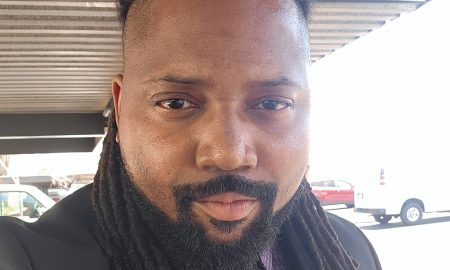
Today we’d like to introduce you to Cam DeCaussin.
Every artist has a unique story. Can you briefly walk us through yours?
I grew up in a small, distant suburb of Detroit, Marine City. It is the quintessential Rockwellian image of small-town life. Growing up relatively poor in a household of 6, there weren’t many luxuries. Paper and pencils were cheap and being consumed with TV, I would draw cartoon characters. As time went on, I became the typical high school angsty Goth kid and my art followed suit. It was during high school though, that I began to flirt with the idea of being an artist. I went from something in the medical field to medical illustration, to illustration.
After landing on illustration as my path forward, I went on to attend Grand Valley State University to study and receive my BFA. It was in art school, that I was exposed to oil painting and quickly fell in love with the medium. During my undergrad, I had also lost my dad to suicide and my whole experience with the world changed. There was an emptiness and a shame that existed and I became hyper-awareness to my surrounding, everything had additional meaning and history. I became focused on nostalgia, memory, and the past. I started looking into others’ lives and trying to make sense of their surroundings, how their spaces could tell a story. It was during this time I decided to apply to grad school. This brought me to ASU to study painting and drawing and to continue exploring.
Please tell us about your art.
What I paint has been a weird realization that I think comes from being that quiet, indoor kid growing up. You become an observer; of your environment, of your family, of your friends. You notice things many people don’t pay attention to – the in-between spaces. Added to this my mom is an avid soap opera watcher, and growing up in a small town you know or speculate other people’s business.
Since being in Phoenix, the feeling of separation and anonymity between each other has been heighted. We are distant, we are aloof, strangers in our own neighborhood. I noticed the change in the purpose of the yard, it was an extension of the home, another room to be explored. There are physical walls people built that became a barrier between neighbors that fences never seemed to be and the idea of public private space blurred even more. I would go for walks in the evening and night, beginning to flirt with the idea of voyeurism. Documenting people’s homes and wondering what goes on inside.
It was during this time I came across an invented word, sonder that really became the epitome of what I am trying to express. Sonder is the realization that each random passerby is living a life as vivid and complex as your own. I combined this with research in social-psychological commonalities we all share, predominantly protagonist disease and the fundamental attribution error. Both of these mentalities are really rooted in the importance of the self, that I am the center of the world, of my life story, that I faults are incidental. I have a new perspective when I go on my walks. Each home is less of a different TV show to speculate at and is now how I am a part of a person’s life with each house I pass, however insignificant it may be. I am a background character in their lives. When I go to paint these scenes they become reminders of all the complexities of the people around us that we are often completely unaware of.
What do you think is the biggest challenge facing artists today?
I think artists face an uphill climb in a way that previous generations haven’t. The culture of art consumption is evolving in this digital age. The oversaturation of visual stimuli makes what we do harder to connect with people. Artists are fighting for those same eyes that advertising is, that TV is, our phones, our families, our friends whether on social media or in real life. Our competition is vaster than ever; our attention spans are shorter than ever. Art is the backdrop for selfies, a like, a follow, a post, a pin. As an artist, I am guilty of all of this myself, so I can only imagine for non-artists being overwhelmed, distracted and divided on all fronts as to what to look at. We are in a time of the most exposure of historical, established and emerging artist that has ever existed. It really comes down to finding a way to cut through all the noise for a person to be present with a piece of art that they truly enjoy.
How or where can people see your work? How can people support your work?
I am currently in the Arizona Biennial at the Tuscon Museum of Art which is on display until September 16. I also have an upcoming two-person show with fellow painter Travis Ivey, October 8th – October 25th at Eric Fischl Gallery on Phoenix College’s campus. My work can also be seen at www.camdecaussin.com and social media @rcdecaussin
Contact Info:
- Website: www.camdecaussin.com
- Email: rcdecaussin@gmail.com
- Instagram: https://www.instagram.com/rcdecaussin/
- Facebook: https://www.facebook.com/cam.decaussin


Image Credit:
Amy DeCaussin
Getting in touch: VoyagePhoenix is built on recommendations from the community; it’s how we uncover hidden gems, so if you know someone who deserves recognition please let us know here.
Popular
-

Phoenix’s Most Inspiring Stories
-

Building Love With Purpose: Darryl & DeLonda Tucker on Faith, Resilience, and Expansion
-
Andrea Savarese Is Redefining Veterinary Care Through Calm, Connection, and Compassion
-
Sun Cities 4 Paws Rescue Is Building a Sustainable, Compassion‑First Future for Feline Welfare