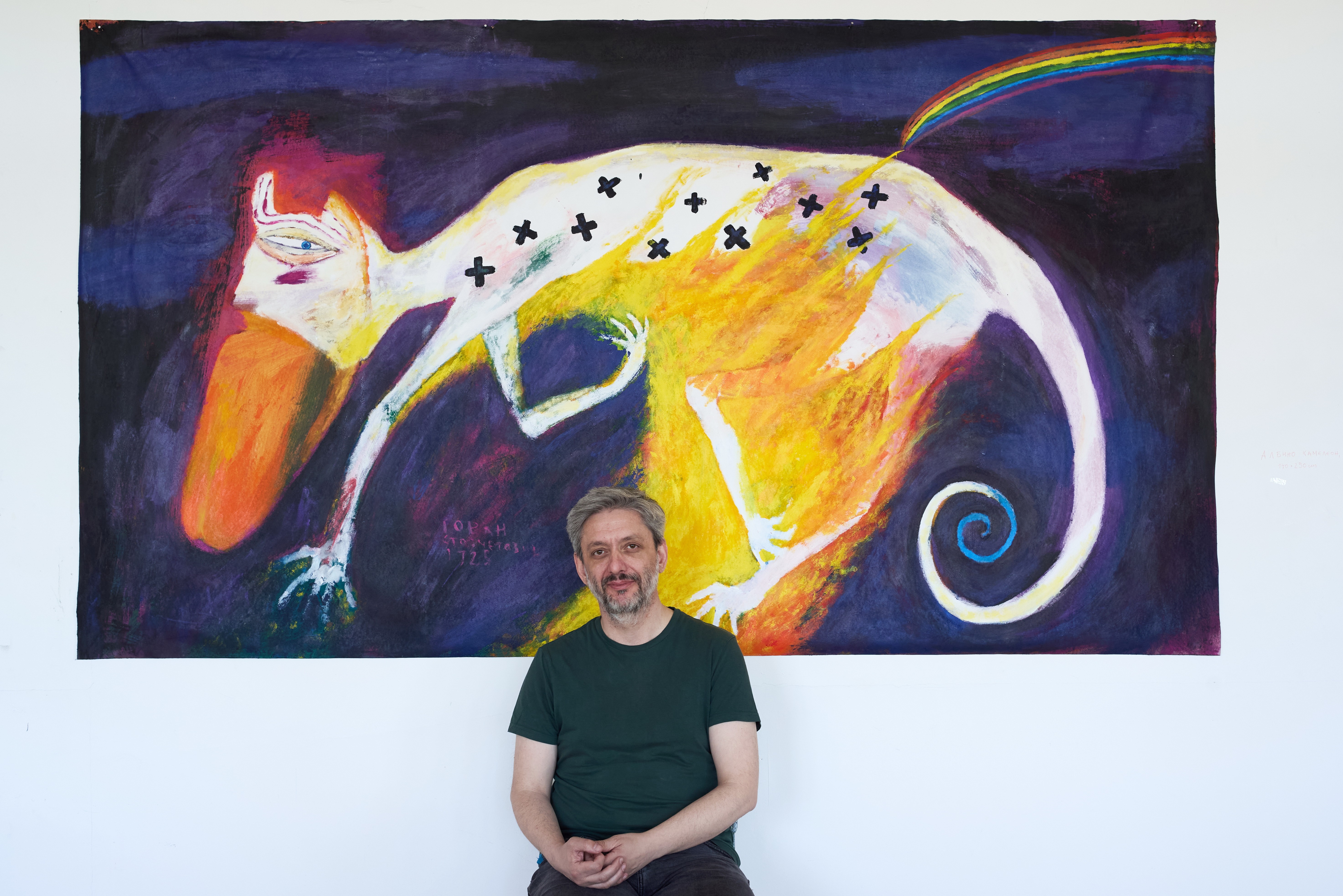
Today we’d like to introduce you to Goran Stojčetović.
Hi Goran, thanks for joining us today. We’d love for you to start by introducing yourself.
I grew up and developed as an artist in a social reality marked by political instability, violence, war, displacement, and profound changes in the communities around me. These experiences made me very aware of the ways in which society creates boundaries between those who belong and those who are pushed to the margins. Over time, this became an important part of my understanding of art.
I became interested in creating spaces where people whose creativity is usually overlooked could be recognized on their own terms. In 2013, I founded the Art Brut Serbia Association, which became a platform for developing and promoting the work of artists outside the established art system.
One of the most important parts of this work was establishing and leading an Art Brut Studio at the Military Medical Academy in Belgrade, within the psychiatric clinic. I wanted to create a genuine space for artistic creation, where people could be approached first as creative individuals rather than through the institutional categories assigned to them. The studio still exists today and remains the only Art Brut studio in the Balkans.
This work changed my understanding of what an artist can do within society. I became less interested in the idea of art as something produced for an existing cultural system and more interested in its ability to open spaces for people, experiences, and forms of expression that society tends to overlook.
At the same time, I continued developing my own artistic research through drawing. What I was discovering through my own practice gradually connected with everything I had learned through working with other people and observing different forms of creativity. After decades of this process, it eventually led to what I call Depth Art.
So the path that brought me to where I am today has been a continuous movement between personal experience, social engagement, and artistic research. I have never seen these as separate things. For me, they are different aspects of the same attempt to understand what it means to be human and how art can make something visible that would otherwise remain unseen.
Would you say it’s been a smooth road, and if not what are some of the biggest challenges you’ve faced along the way?
It has definitely not been a smooth road. Some of the biggest obstacles came from circumstances that were much larger than art itself. I experienced war and displacement, and had to rebuild my life in a completely different environment. Later, many of the difficulties came from working with forms of creativity that were not easily accepted or understood by the established cultural system.
When I began working with Art Brut, there was very little infrastructure or institutional understanding of this field in Serbia and the wider region. I often had to build the conditions for the work myself — creating opportunities for artists, developing audiences, and establishing connections with institutions and people abroad. I financed this work myself and did it without payment, investing my own time and resources and organizing my life around promoting the idea. At the same time, I brought together other people who believed in what we were doing and were willing to contribute their time, knowledge, and energy.
But perhaps the most difficult challenge was to remain faithful to the work when there was no guarantee that it would be understood. I often had to move forward before there was an established framework for what I was trying to do.
Looking back, I don’t think those obstacles were separate from my development as an artist. They forced me to become more independent, to question existing structures, and to find my own ways of working. In that sense, the difficulties were not simply something I had to overcome. They became part of the process that eventually brought me to where I am today.
Appreciate you sharing that. What else should we know about what you do?
My work moves across several forms of visual art, including drawing, painting, and theatre scenography. I have never felt the need to limit myself to a single medium, because for me the medium is a way of entering a particular situation rather than a fixed identity.
Drawing, however, has become the central field of my long-term research. I approach it as a process of discovery, following lines, associations, forms, and transformations as they emerge rather than beginning with a predetermined image. Over the past three decades, this has developed into an extensive investigation of perception, consciousness, the body, and the formation of visual experience.
The result of this research is what I call Depth Art. It is not a style or a technique, but a way of understanding and developing the artistic process that has emerged from my own practice. I continue to develop it through drawing, painting, writing, and theoretical research.
What is most important to me is that these different activities are not separate careers or disciplines. They are different manifestations of the same artistic way of thinking. Whether I am drawing, painting, or working in theatre, I am interested in how a situation is constructed, how elements begin to relate to one another, and what can emerge from those relationships.
What distinguishes my work is therefore not a particular medium or visual style, but the fact that I have developed my own continuous field of research across different forms of artistic practice. The work itself is always part of that research, rather than an illustration of an idea that already exists.
How do you think about luck?
Luck has certainly played a role in my life, although I have never understood it simply as good or bad luck. Many of the most important turning points in my life came through circumstances that I did not choose and could not control. Some of them were extremely difficult, while others unexpectedly opened completely new directions.
What matters to me is what happens after such an event. I tend to respond to circumstances rather than wait for ideal conditions. Something that initially appears to be an obstacle can sometimes become the starting point for a new possibility. The same is true in my artistic work: I often begin with something unexpected and then try to understand where it can lead.
There have also been fortunate encounters — people who appeared at the right moment, unexpected opportunities, and situations that allowed my work to move further than I could have planned. But I don’t think of these things as something that simply happened to me. They became meaningful because I recognized their potential and acted on them.
In that sense, I would say that chance has been important in my life, but my relationship with chance has been even more important. I try to remain open to what I cannot predict, while taking responsibility for what I do with it.
Contact Info:
- Website: https://goranstojcetovic.crevado.com/
- Instagram: https://www.instagram.com/goran.stojcetovic/
- Facebook: https://www.facebook.com/goran.stojcetovic
- LinkedIn: https://www.linkedin.com/in/goran-stoj%C4%8Detovi%C4%87-b4224b78/
- Other: https://www.cambridge.org/core/journals/epidemiology-and-psychiatric-sciences/article/roots-of-the-concept-of-depth-art/A9E93659042C76D7CC623FB62D080293