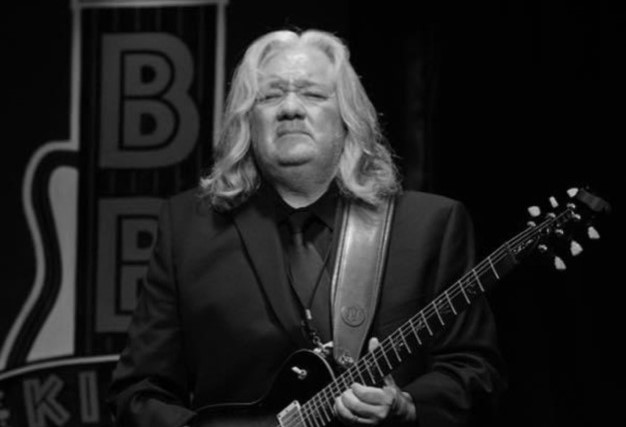
Today we’d like to introduce you to Darryl Porras.
Alright, so thank you so much for sharing your story and insight with our readers. To kick things off, can you tell us a bit about how you got started?
I’ve always wanted to have my own band, and more specifically blues band since I was in my teens. I was highly influenced by Stevie Ray Vaughan to play guitar and to play the blues. I formed my band, Big Daddy D and the Dynamites, in Prescott in October of 1999 with some close friends of mine. At that time, I was in my mid-20s and had some sideman experience in other bands, but moving to frontman was a huge shift in responsibility in that I would book the band, front the band, haul the PA, pick the songs, and sing the songs. Starting a band with no true experience is daunting. We were young and trying to prove ourselves as musicians amongst a ton of other bands WITH experience, history, and tremendous reputations. It’s a situation where we had to take just about any gig to work which meant working weird venues and events and backyard parties. Fortunately, my band members and I were on the same page and just kept grinding. Eventually, we managed to work our way to gigging 3-5 nights a week all up and down Whiskey Row. Whiskey Row in Prescott is a great place to grow your musical chops because there’s an opportunity to perform 6 nights a week. Within three years, we were working 3-4 nights solid each week.
We entered the Phoenix Blues Society’s blues competition, Blues Showdown, many times, and won in 2007, and represented Arizona in the world prestigious International Blues Challenge in Memphis in 2008. We didn’t place, but we gained a lot of good experience, and the band took off from that point. We played Glendale Blues and Jazz several times as well as Blues Blast, Bisbee Blues Festival, and many city events around the state.
I’ve managed to keep the band running for 24 years by learning to be flexible. A key moment was at the end of 2011 when several key members decided to leave the band to pursue other options. It was tough because we were all friends and had so much invested in the band and each other. We had been together for 12 years. I had to learn to pivot and bring in different players with different songs and still maintain quality and viability. No small task for a blues band. I’ve learned to have several different versions of the band to present based on the type of venue or event. This included a long stint with a harmonica player and various keyboard players as well as a long line of bassists and drummers.
In 2015, I moved to Phoenix for a career advancement in my day job. Once again, this would be a lesson in flexibility and building a second lineup to play in Phoenix. Finding the right players for the music and for the hang can be challenging. At this point, I’m working throughout Arizona with different lineups based on the region. All of the players are competent and good people. The goal is to keep the musicality at high levels and continue booking higher profile gigs. We work quite a bit at the Rhythm Room and Westside Blues and Jazz as well as in Prescott, Cottonwood, and Flagstaff.
In addition to my own band, I’ve done side work with many great players, including Arizona Blues Hall of Famers RD Olson and Ray Desylvester and Blues Music Award nominees Lurrie Bell and Kat Riggins.
My current Phoenix lineup features Betty Jo Vachon on vocals, Rick Mutter on keys, and Rachelle Romeo on sax as well as Dr. Bob Sellani on drums and Scott Jeffy on bass. It’s a killer, dynamic group. My Northern Arizona lineup is Roger Smith, Bob Sellani Rick Mutter or Tom McMcmillian, and sometimes harmonica ace, Garry Segal. In addition to the gigs, I work several jams around the state at the Blooze Bar, the Old Corral (Cornville), and Charley’s (Flagstaff).
Can you talk to us a bit about the challenges and lessons you’ve learned along the way? Looking back, would you say it’s been easy or smooth in retrospect?
Playing music is a passion and the passion has to burn hot enough to offset all of the ‘other’ band manager duties to make gigs happen. Booking gigs is challenging. There are very few true music venues. Even fewer venues that will bring in blues. The battle is to stay true to your music and stay viable to the venue.
Keeping a good core of musicians in your band is always a challenge. The best musicians work in multiple projects and may not be available. Booking early and reserving musicians is helpful as well as having decent backups on call. I also focus on having decent people in my band. People who will show up on time, treat others well and with respect, and help.
As many sole proprietors will say, I am the owner, the dishwasher, the server, the manager, marketing man, complaint department. The administrative duties are far greater than playing music or learning your instrument. A lot of time can be spent updating a website, or a Facebook page, following up on inquiries, scheduling rehearsals, making set lists, sharing gig details (multiple times), or simply trying to choose songs to rehearse.
Time and effort become of more of a reality for me as I get older. I’m starting to weigh my time commitment of being on a gig versus being home with family as well as general wear and tear on the body. Most performance times are now three hours; however, 2-4 hours can be added for drive, setup, and tear-down time.
It’s hard to make a living playing music and these days it’s difficult to break even on gigs. I’ve learned to take only good gigs. Good gigs, to me, are not monetarily driven, although can be. For me, good gigs are venues with good, responsive crowds so that the energy coming off the stage is felt by the audience and returned the band. It is a valuable connection, and it is palpable.
Alright, so let’s switch gears a bit and talk business. What should we know about your work?
Music is my passion project. I love to play guitar and make music with my bandmates. It feeds my soul and does bring in a passable side income when used with some cost-cutting. However, my day job pays the bills.
I graduated from NAU in 91′ with a BS in Accounting and got my MBA from U o P in 09′. My current day job is working for the State of Arizona under the Division of Child Support Services. I supervise a team of 6 people who specialize in calculating child support arrears. It is a unique detailed oriented job with many challenges given some of the legal complexities of court orders. No two cases are alike. It’s a gratifying position in that we facilitate, in some small form, our customers being self-sufficient. I’ve been with the State for 21 years.
In short, the day job keeps the dream alive.
So, before we go, how can our readers or others connect or collaborate with you? How can they support you?
There are many ways to support local bands and musician. They are cliche but true. Show up to the venues and buy a drink or two. Bring a friend if you can. The reality is that the venues need to make money to continue to provide live music. It’s a nuanced relationship between venue, band, and patrons. If you can’t show up, follow a band on Facebook or Instagram and share their music or announcements about where they will be performing. Some more obvious items are buying the merchandise like the CDs, downloads, t-shirts, or subscribing to the YouTube channel. Many musicians are now on YouTube and can have some type of revenue stream with increasing subscribers.
If you know someone who has a venue and wants to have live music, be the connect. I don’t mind following up if you have a lead about a venue wanting live music. I also don’t mind having a good honest conversation about what a venue needs to have a successful evening of music. It’s not as easy as just saying we want live music.
The bottom line is to recognize I’m trying to run the business of a band which has many moving pieces similar to any other sole proprietorship. Music is one small component to the bigger picture.
Contact Info:
- Website: bigdaddy.net
- Instagram: darrylporras
- Facebook: FB: Big Daddy D and the Dynamites
- Youtube: https://www.youtube.com/results?search_query=big+daddy+d+and+the+dynamites+


Image Credits
Mark Spoerner