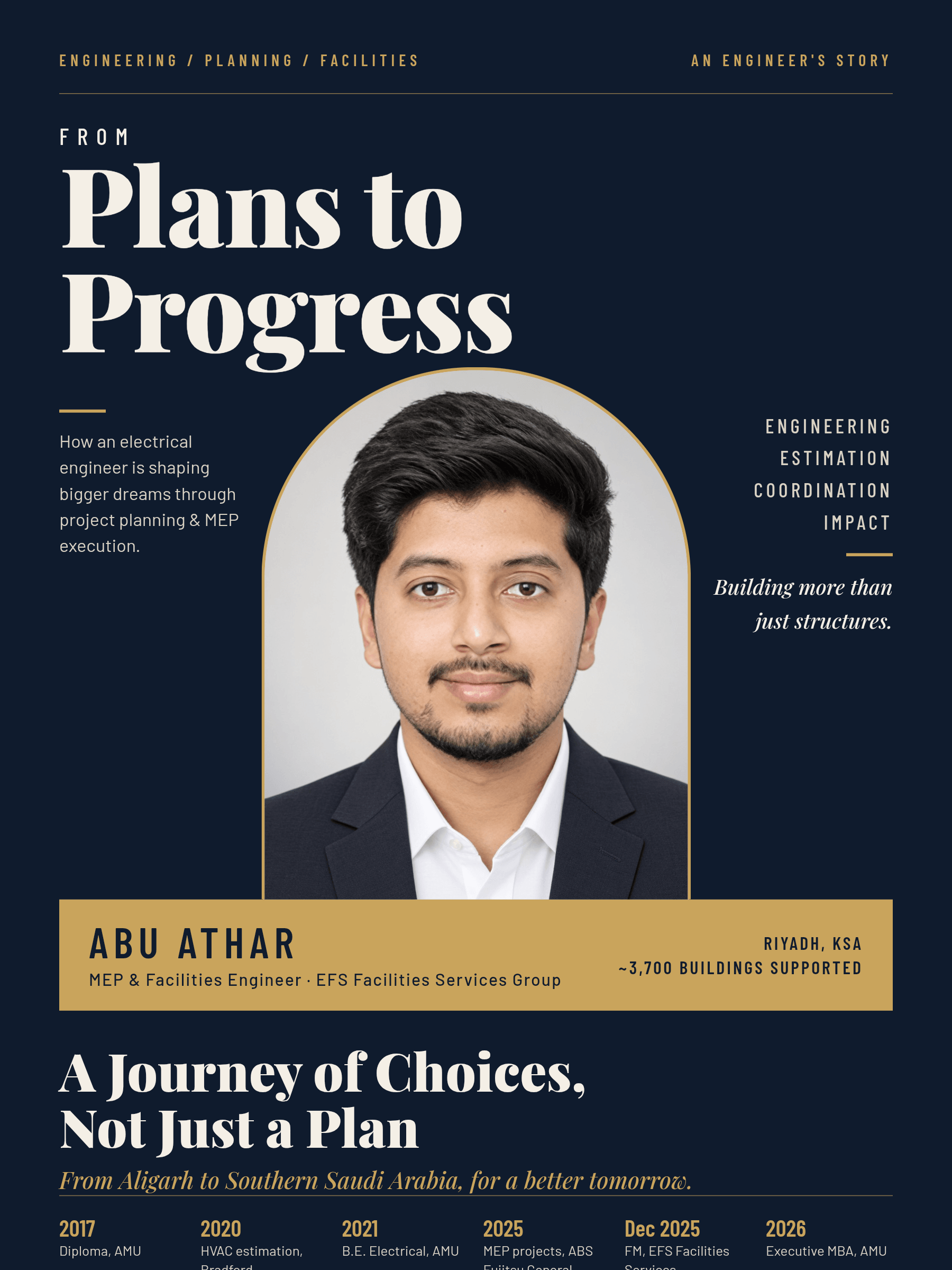
Today we’d like to introduce you to Abu Athar.
Abu, we appreciate you taking the time to share your story with us today. Where does your story begin?
From Dreams to Direction: The Journey of Never Giving Up
Success is not always about how quickly you reach your destination; sometimes, it is about how many times you find the courage to continue.
Every successful journey begins with a dream. However, the path between dreaming and achieving is rarely easy. It is filled with uncertainty, challenges, failures, sacrifices, and moments when giving up seems easier than moving forward. My journey has taught me that success is not a single achievement but a continuous process of learning, adapting, and improving.
Step 1: The Beginning – Having a Dream
Every journey has a starting point. Mine began with a simple dream: to build a meaningful career, become independent, and make my family proud.
Like many students, I had ambitions but did not have a complete roadmap for achieving them. I understood that education could open doors, but I also knew that a degree alone would not be enough. I needed discipline, practical knowledge, patience, and the courage to explore opportunities beyond my comfort zone.
Step 2: Education – Building the Foundation
My educational journey began with a Diploma in Electronics Engineering. During this period, I developed an interest in technology, electrical systems, and practical engineering applications.
Rather than stopping there, I decided to challenge myself further by pursuing a Bachelor’s degree in Electrical Engineering.
This transition taught me an important lesson: never stop learning simply because you have achieved one milestone. Every qualification should become a stepping stone towards a bigger goal.
My academic projects, technical training, and internships helped me understand how theoretical knowledge translates into real-world applications.
Step 3: Exploring the Professional World – Learning Beyond Books
Entering the professional world was a completely different experience.
During my internships and industrial training, I got opportunities to understand testing, solar power systems, electrical engineering, and practical project environments.
I gradually realised that engineering was not just about calculations, drawings, and technical knowledge. It was also about teamwork, communication, coordination, problem-solving, and taking responsibility.
There were many things I did not know, and that was perfectly fine. Instead of being discouraged by my limitations, I started treating every new responsibility as an opportunity to learn.
Step 4: Facing Challenges – The Real Classroom
One of the biggest lessons in my journey was understanding that professional growth does not always follow a straight line.
I explored different responsibilities, including project engineering, estimation, costing, quantity surveying, commercial coordination, and facilities management.
At times, changing roles and learning unfamiliar subjects seemed challenging. I had to understand new processes, interact with different stakeholders, manage responsibilities, and adapt to different working environments.
But gradually, I discovered something important: every experience was adding a new dimension to my professional personality.
Technical knowledge taught me how systems work. Commercial responsibilities taught me how to understand costs and contracts. Coordination taught me how to work with people, while facilities management introduced me to operational performance, service quality, and accountability.
I stopped looking at different experiences as unrelated career moves and started seeing them as pieces of a bigger picture.
Step 5: Stepping Beyond Boundaries – Embracing New Opportunities
One of the most important decisions in professional life is having the courage to step outside your comfort zone.
Working in the Gulf region became another important chapter in my journey. It brought new responsibilities, professional exposure, and the opportunity to understand international workplace standards.
Adapting to a different country, professional culture, and working environment was another learning experience.
I realised that opportunities do not always come when we feel completely prepared. Sometimes, we have to accept the challenge first, learn along the way, and grow into the responsibility.
Step 6: Investing in Yourself – Education Never Ends
While gaining professional experience, I realised that technical expertise alone would not be sufficient for my long-term ambitions.
I wanted to understand management, leadership, strategy, planning, and decision-making.
This motivated me to pursue an Executive MBA at Aligarh Muslim University.
For me, this was more than another academic qualification. It represented a commitment to continuous improvement.
I began understanding that a successful professional must not only know how to execute a task but also understand why it is being executed, how resources should be managed, how teams should be led, and how decisions affect the bigger organisational picture.
Step 7: Finding Direction – Connecting Every Experience
Looking back, I can see how every stage has contributed to my development.
My engineering education gave me a technical foundation. My project and commercial experiences developed my understanding of execution, cost, and coordination. My facilities management responsibilities strengthened my approach to operational performance and accountability. My management education is helping me develop a broader perspective.
What once appeared to be different and disconnected experiences is gradually becoming a unified professional journey.
I have learned that sometimes we do not need to have every answer at the beginning. We simply need to keep moving in the right direction.
Step 8: The Road Ahead – Success Is a Continuous Journey
I do not consider my journey complete. In fact, I believe the most exciting chapters are still ahead.
There are more skills to develop, responsibilities to undertake, challenges to overcome, and goals to achieve.
I want to continue growing not only as an engineer but also as a professional capable of leading projects, managing people, making informed decisions, and creating meaningful value.
My definition of success has also evolved. Earlier, success meant securing a good job. Today, it means becoming competent, responsible, financially independent, continuously learning, and being able to contribute positively to society.
A Message to Every Dreamer
If there is one thing I would like readers to take away from my journey, it is this:
Do not compare your Chapter 1 with someone else’s Chapter 10.
Everyone has a different starting point, different circumstances, and a different pace of growth. Some people achieve their goals early, while others take a longer route. What matters is not how quickly you move but whether you continue moving forward.
Never be ashamed of starting small. Never consider changing directions a failure. Never allow a lack of experience to become an excuse for not trying.
Learn from every opportunity, accept your mistakes, respect the people who support you, and remain humble regardless of how far you travel.
Most importantly, remember that your background does not define your destination. Your determination, discipline, and willingness to learn can shape your future.
Dream with courage. Start with what you have. Learn at every step. Work with consistency. And never stop becoming a better version of yourself.
Because the most inspiring success stories are not written by people who never faced difficulties; they are written by people who refused to let difficulties write the ending.
Alright, so let’s dig a little deeper into the story – has it been an easy path overall and if not, what were the challenges you’ve had to overcome?
The Battles Behind the Journey
Behind every achievement, there are battles that people rarely see. My journey was no exception.
I faced uncertainty about my career, struggled to bridge the gap between academic knowledge and practical experience, and had to prove myself in unfamiliar professional environments. There were moments when I questioned my decisions, wondered whether I was progressing at the right pace, and felt the pressure of meeting both personal and professional expectations.
Changing professional roles meant starting the learning process repeatedly. Moving away from familiar surroundings required courage, while balancing professional responsibilities with higher education demanded discipline and sacrifice.
Perhaps the biggest challenge was learning to be patient with myself. I realised that success does not happen overnight, and comparing my progress with others would only distract me from my own goals.
I learned to turn uncertainty into curiosity, pressure into experience, mistakes into lessons, and challenges into opportunities for improvement.
These obstacles did not make my journey easier, but they made me stronger, more adaptable, and more determined.
I gradually understood that obstacles are not always signs that we are on the wrong path; sometimes, they are the very experiences preparing us for the destination we are working towards.
Thanks – so what else should our readers know about your work and what you’re currently focused on?
I am an Electrical Engineer with professional experience across the MEP, EPC, project coordination, commercial management, and facilities management sectors. My work primarily focuses on managing and coordinating engineering and operational activities, with an emphasis on cost management, quantity surveying, project performance, contract compliance, and service delivery.
Over the course of my professional journey, I have had the opportunity to work across different functions, which has helped me develop both technical and managerial perspectives. My engineering background allows me to understand the technical aspects of projects, while my exposure to estimation, costing, billing, vendor coordination, client interactions, and facilities operations has strengthened my commercial and management capabilities.
I would describe myself as someone who is adaptable, analytical, and always willing to learn. I enjoy understanding how things work, identifying areas for improvement, solving practical problems, and coordinating with different teams to achieve common objectives. I am particularly interested in project planning, project controls, cost optimisation, and management.
What I am most proud of is the fact that I have continuously challenged myself to grow beyond my academic qualifications and initial professional role. Rather than restricting myself to one particular domain, I have explored different areas of the engineering and project management industry, embracing new responsibilities and learning from every experience. Pursuing an Executive MBA alongside my professional career is another step towards strengthening my leadership and management capabilities.
What sets me apart is my willingness to connect technical engineering knowledge with commercial understanding and operational management. I believe that successful project delivery requires more than technical expertise; it requires planning, financial discipline, effective communication, teamwork, and the ability to see the bigger picture.
Ultimately, I aspire to grow into a well-rounded project management professional who can lead teams, manage complex projects, make informed decisions, and create lasting value for organisations.
Networking and finding a mentor can have such a positive impact on one’s life and career. Any advice?
I believe finding the right mentor and building a strong professional network can play a significant role in anyone’s career. One of the most important lessons I have learned is that networking should not be limited to connecting with people when we need a job or an opportunity. It should be about building genuine professional relationships, exchanging knowledge, and learning from one another.
My advice to young professionals is to be proactive. Do not hesitate to approach experienced people in your industry, ask meaningful questions, seek feedback, and show genuine interest in their experiences. Platforms like LinkedIn can be extremely useful for connecting with industry experts, professionals, and people working in roles you aspire to pursue.
I also believe that a mentor does not necessarily have to be one person who guides you throughout your entire career. Different people can mentor you at different stages. One person might help you develop technical expertise, another might guide you in leadership, while someone else might help you understand career opportunities and industry expectations.
What has worked well for me is maintaining a learning mindset, staying connected with professionals from different backgrounds, observing how experienced people handle challenges, and being willing to learn from both successes and mistakes.
Most importantly, I would encourage young professionals to focus on building their own capabilities before expecting opportunities from their network. Be sincere, stay humble, respect people’s time, and try to offer value wherever possible.
My philosophy is simple: Your network may open a door, but your knowledge, attitude, consistency, and hard work will determine how far you go after entering it.
Contact Info: