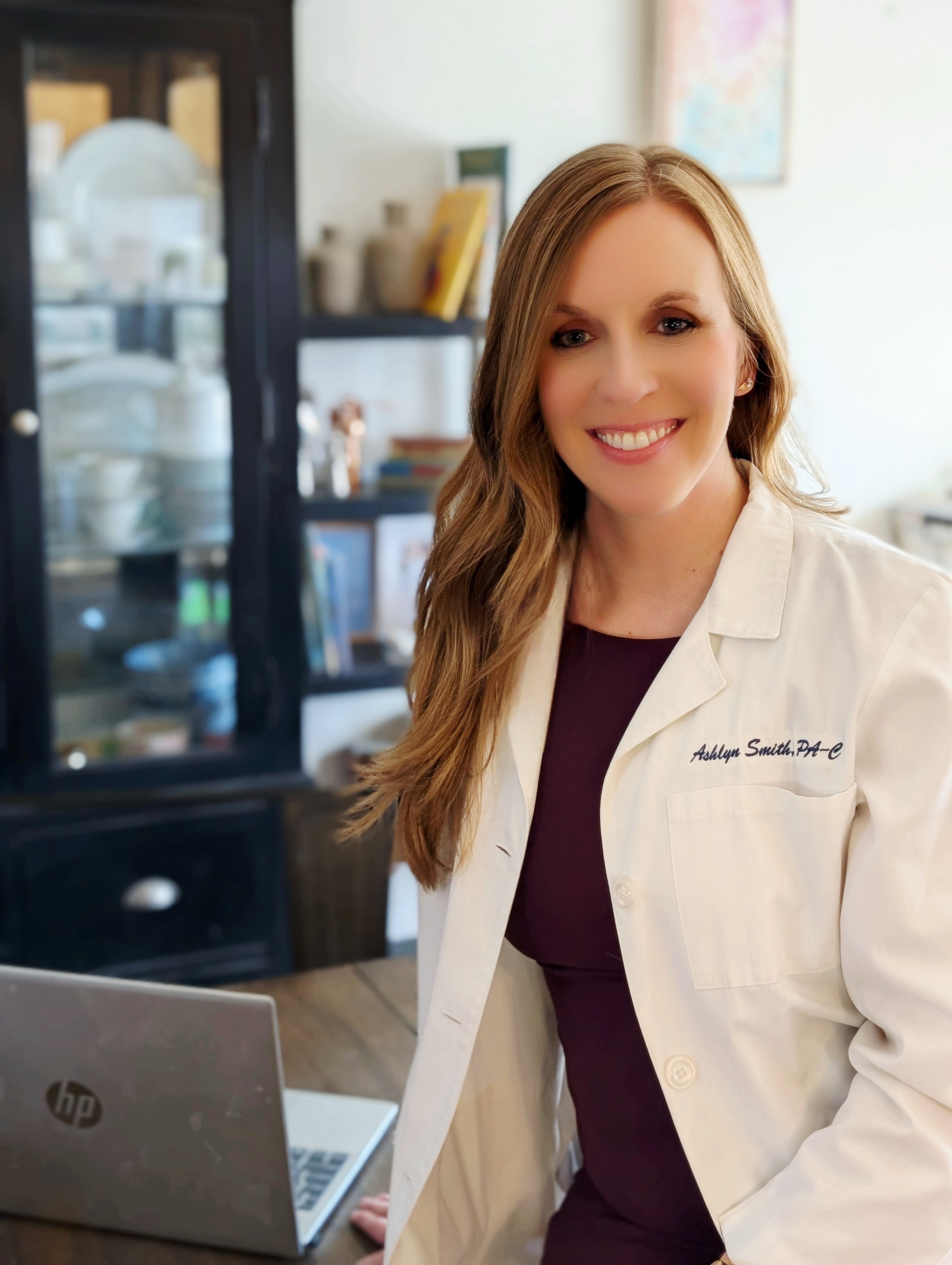
Today we’d like to introduce you to Ashlyn Smith.
Hi Ashlyn, thanks for joining us today. We’d love for you to start by introducing yourself.
My journey to ELM Endocrinology and Lifestyle Medicine really wasn’t a straight line. It was more of an evolution.
I’ve been a PA for about 15 years and early in my career I found myself drawn to endocrinology because I loved the complexity. But over time, I realized that what fascinated me most wasn’t just the lab value or the diagnosis. It was the person behind it. Why was this happening? What was getting in the way? What could we actually change that would make a meaningful difference in someone’s life?
Along the way, I became deeply involved in medical education, mentorship, and professional leadership. I’ve taught PA students, lectured nationally, mentored other clinicians, and served in leadership within the PA community. I also became board-certified in lifestyle medicine because I wanted a better framework for helping people address the things that influence their health every single day beyond just prescribing another medication.
At the same time, I was becoming increasingly frustrated with the limitations of traditional healthcare. I wanted to be able to spend more time with people. I wanted conversations about nutrition, sleep, stress, movement, medications, hormones, glucose, and mental and emotional well-being to actually fit into the same visit. I wanted to practice medicine in a way that felt more human and more aligned with what I believed healthcare could be.
That’s the heart of where ELM came from.
Building ELM has been both incredibly exciting and an exercise in flexibility. I’ve had to learn the business side, rethink what it means to be a clinician and an entrepreneur, build systems from the ground up, and get comfortable doing things before I felt completely ready.
Today, ELM is my way of bringing all of those pieces together: endocrinology, lifestyle medicine, education, advocacy, and genuinely personalized care. It’s a practice built around the idea that there is a whole person sitting in front of me, not just a diagnosis or a lab value.
I think I’ll always be on the journey with ELM as it continues to evolve as I do. That’s one of the things I love most about it.
Would you say it’s been a smooth road, and if not what are some of the biggest challenges you’ve faced along the way?
Building ELM has not been a smooth road, and I think that’s probably true of most things that are worth building.
One of the biggest challenges has been learning how to build a business while still being a clinician. I knew how to take care of patients. I knew how to teach. I knew endocrinology and lifestyle medicine. But running a business requires a completely different set of skills, including marketing, systems, finances, technology, operations, boundaries, and making decisions when there isn’t a roadmap sitting in front of you.
There have also been plenty of moments where I questioned whether I was doing things the “right” way. Healthcare gives us a pretty well-defined path: go to school, get licensed, get a job, see patients, sleep, repeat. Stepping outside of that path and building something of my own meant getting comfortable with uncertainty and with not having someone else tell me what the next step was supposed to be.
Another challenge has been resisting the temptation to build ELM around what a medical practice has always looked like. I’ve had to continually come back to the question: What kind of care do I actually want to provide, and what kind of practice allows me to provide it well?
That has meant making some unconventional choices and changing course when something didn’t fit. It has also meant being patient with growth. There have been seasons when I wanted things to move faster, seasons when I wondered if I could keep up, and seasons when it felt like I was not making any progress at all.
Then there’s the very personal side of entrepreneurship. Building something that carries your name, your expertise, your values, and your vision can feel incredibly vulnerable. When you’re the business owner, there isn’t always a place to hide when something doesn’t work.
But I think those challenges have been some of the most valuable parts of the journey. They’ve forced me to get clearer about what I’m building, who I’m building it for, and what I’m unwilling to compromise on.
It hasn’t been smooth, but I’m not sure I would want it to be. A lot of the things I value most about ELM came from having to figure them out the hard way.
Thanks for sharing that. So, maybe next you can tell us a bit more about your business?
ELM stands for Endocrinology & Lifestyle Medicine, and at its heart, it’s a direct-pay, telehealth practice built around a pretty simple belief: healthcare should be about the whole person, not just the lab value, diagnosis, or number on the scale.
I specialize in endocrinology and metabolic health, with a particular focus on diabetes, insulin resistance, obesity, thyroid health, hormones and menopause, and the overlapping realms of metabolic and lifestyle health. But I don’t want ELM to be defined by a list of diagnoses. What really sets it apart is HOW I approach those diagnoses.
At ELM, we look at the full picture: medications and supplements, nutrition, sleep, stress, movement, glucose patterns, hormones, labs, symptoms, goals, barriers, and the realities of someone’s actual life. Lifestyle medicine isn’t an add-on or a handout at the end of the visit. It’s integrated into the medical care.
I also intentionally built ELM differently from the traditional healthcare model. As a direct-pay practice, I’m not trying to fit someone’s care into an insurance-defined visit or rush through a long list of concerns. The goal is to create space for meaningful conversations, shared decision-making, education, and a plan that actually makes sense for the individual sitting in front of me.
One of the things I’m most proud of about the ELM brand is that I think people can feel what I mean when I say, “Where Science Meets Soul.” I want ELM to be deeply evidence-based without ever becoming cold or clinical. I can nerd out over an A1c, insulin resistance, thyroid physiology, CGM data, or an endocrine pathway. At the same time, I never want to lose sight of the human being attached to that data.
I’m also proud that ELM has become a place where my different passions can coexist. Clinical medicine, lifestyle medicine, diabetes technology, patient education, advocacy, and medical education all belong here. It isn’t just about treating disease. It’s about helping people understand their health, giving them tools and choices, and partnering with them as they make meaningful changes.
If there’s one thing I would want readers to know about ELM, it’s this: you don’t have to choose between evidence-based medicine and care that feels personal, compassionate, and human. You can have both.
That’s what I’m building with ELM.
How do you think about luck?
I think luck played a pretty significant role in how ELM came to be, but probably not in the way people typically think about luck.
There was a point in my career when I knew I needed something different. I didn’t necessarily know exactly what I was going to do next. I just knew that I wanted something more human. I wanted more connection with patients. I wanted more autonomy over how I practiced medicine. I wanted to be able to build something that felt more aligned with the kind of clinician I wanted to be.
Then, almost comically, I walked past a literal sign for a “PA Entrepreneur Workshop.”
I remember thinking, “Well… apparently I’m supposed to pay attention to this.” So I went.
That’s where I met Phoebe, who is a compliance expert, and that introduction ended up being one of those seemingly small moments that completely changed the trajectory of my life. I started learning about entrepreneurship, compliance, and what it actually meant to build something outside of the traditional healthcare model.
But at some point, I had to move from “Maybe I could do this” to actually having the confidence to launch ELM.
That was a big leap for me. I didn’t have every answer. I didn’t have everything figured out. But I had enough experience, enough conviction in the kind of care I wanted to provide, and enough confidence to say, “I’m going to try.”
ELM wasn’t the only thing that grew from that experience. I started seeing how many other PAs were asking the same kinds of questions I had been asking: “Is there another way? What else could my career look like? Can I build something different?”
That eventually led to creating The Independent PA Collective (IPAC) with Phoebe, a community for PAs who were looking for something different and wanted support, connection, and a place to explore what might be possible beyond the traditional career path.
So when I think about luck, I think about that literal sign, meeting Phoebe, and all of the people and opportunities that came from that moment. But luck only gets you so far.
You have to be willing to stop and pay attention. You have to be willing to take the leap. And sometimes you have to have enough confidence to build the thing before you have proof that it will work.
So yes, I was lucky. I just also happened to be willing to say “Yes” strategically for what came next.
Pricing:
- Free Discovery Call: Get to Know ELM!
- Membership for twice/month visits: $200/month
- Membership for once/month visits: $125/month
- Membership for once/quarter visits: $175 per quarter
- Standalone visits: $200 per visit
Contact Info:
- Website: www.elm-health.com
- Instagram: https://www.instagram.com/elm.pac
- Facebook: https://www.facebook.com/profile.php?id=61578771123427
- Linkedin: http://linkedin.com/company/elm-endocrinology-and-lifestyle-medicine
- TikTok: @elm.pac