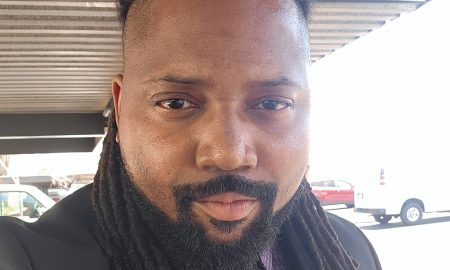
Today we’d like to introduce you to Michael Herbert Dorn.
Michael, please kick things off for us by telling us about yourself and your journey so far.
As an adult, my career path in the arts has been an oblique one, and it has had many vectors. I have worked in the fields of graphic arts, illustration, and landscape design, and scores of other non-art related jobs.
Like many individuals who become a practicing artist, I too wanted to be an artist from a very early age—although, as an adolescent, I didn’t know what being an artist meant. By the time I was in high school, I had conceived of a definition of an Artist that went beyond the notion of making beautiful decorative objects or as an illustration of some sort—I began to think of the Artist as an agent in the formation of culture and the creation of different values. Of course, I didn’t quite express it that way then.
As a youngster, I made drawings from life, portraits of family members and friends, objects around the house—that sort of thing. Also, I was also always interested in what I would later learn to call abstraction—and I made drawings of imagined patterns that I found interesting—although, these were not depictions of actual objects. During my initial years at college, when I began to receive formal training in traditional art practices (drawing, painting, sculpture), I reluctantly accepted the idea that abstraction and “realistic representation” were separate art historical categories.
My initial training in visual arts was as a traditional oil painter. However, I completed my undergraduate degree with a bachelors degree in visual and performing arts, and a major in film and video production. I have always been interested in combining mediums in a wide range of visual expression. In 2016, I began the process of realigning my purpose and direction as an artist when I enrolled in a two-year MFA graduate school program. During that time, as I studied art history more critically, western art history, in particular. I saw its many different aspects as a connected whole in which all its varied traditions relate to other elements of our conceptions of reality. I received my Master of Fine Arts (MFA) degree in August of 2018. I have taken this milestone as the “refocusing” point for my art career.
Can you give our readers some background on your art?
My current work is concerned with issues of representation. One recent project that I have been working on for nearly three years, (Self) Portrait Through The AmeryKahn Prism, is an ongoing installation that debuted last year. In this work, I ask viewers to use their mobile devices that they have set to “invert” colors to view the installation images. In this intermedia network of mixed media painted images, I am interested in reconfiguring the many cascading representations of “the black body.” This installation of interrelated picture elements (“pix/els”), turns the racialized conception of “the black body” on its proverbial head by resisting cultural accommodation to the pictorial and the lexical literalness of this expression.
The pix/els, which are modeled from imagination, memory, direct observation, and inverted color photographs, are stylized with many “traditional” portrait techniques, mixed media, modernist abstract forms, intercultural symbols, textual motifs, and imagined three-dimensional structures that are made primarily of specially prepared paper. By visually juxtaposing a wide variety of painted images, my project seeks to identify, question, and categorize various racial discourses into a unified pictorial matrix to reveal the fallacy and the ideological nature of a racialized world.
(Self) Portrait Through the Amerykahn Prism’s multiple, linked “narratives” are activated as the spectator physically moves while surveying the network. From one pix/el to the next, from one image cluster to the next, the spectator chooses how the images are sequenced in their imagination. This visual exploration takes on a cinematographic quality that is activated by the spectator’s participation in coding, un-coding, and re-coding sequences of images.
The spectator’s digital mobile device, set to invert colors, serves as an intermediary to view the images in an alternative mode. Viewing an analog painting with the aid of a mobile digital media device is an explicitly new way of encountering and extending a painting’s semantic potential by challenging the conventional notion of how we (traditionally) experience or see a “painting.” The inverted view on the screen of the digital device prompts critical questions about the role of visual media in our perceptions of race and difference.
I am also currently working on a series of large canvases that continue and extend my use of the digital mobile device as a means of extending traditional paintings semantic potential.
How do you think about success, as an artist, and what do quality do you feel is most helpful?
I would love it if my work found a way to participate in the larger issues of contemporary visual culture and register within the context of the “art history” that is being written now.
There is no question that exhibition sales are traditionally an important component of measuring an artist’s success. But, I want to create work that is skillfully executed, and that exemplifies criticality in terms of contemporary visual culture. Successful work is work that ventures beyond the cultural status quo—it recodes the cultural cues.
Tenacious hard work both during the formal training stages and the subsequent career practice is absolutely necessary.
Contact Info:
- Address: Michaël Herbert Dorn
27 Ave. du Docteur Arnold Netter
75012 Paris
FRANCE - Website: www.michaelherbertdorn.com
- Phone: +33 (0)6 78 35 11 31
- Email: michael.herbert.dorn@gmail.com
- Instagram: @michael_herbert_dorn_artist
- Facebook: https://www.facebook.com/Michael.Herbert.Dorn


Getting in touch: VoyagePhoenix is built on recommendations from the community; it’s how we uncover hidden gems, so if you know someone who deserves recognition, please let us know here.
Popular
-

Phoenix’s Most Inspiring Stories
-

Building Love With Purpose: Darryl & DeLonda Tucker on Faith, Resilience, and Expansion
-

Andrea Savarese Is Redefining Veterinary Care Through Calm, Connection, and Compassion
-

Sun Cities 4 Paws Rescue Is Building a Sustainable, Compassion‑First Future for Feline Welfare