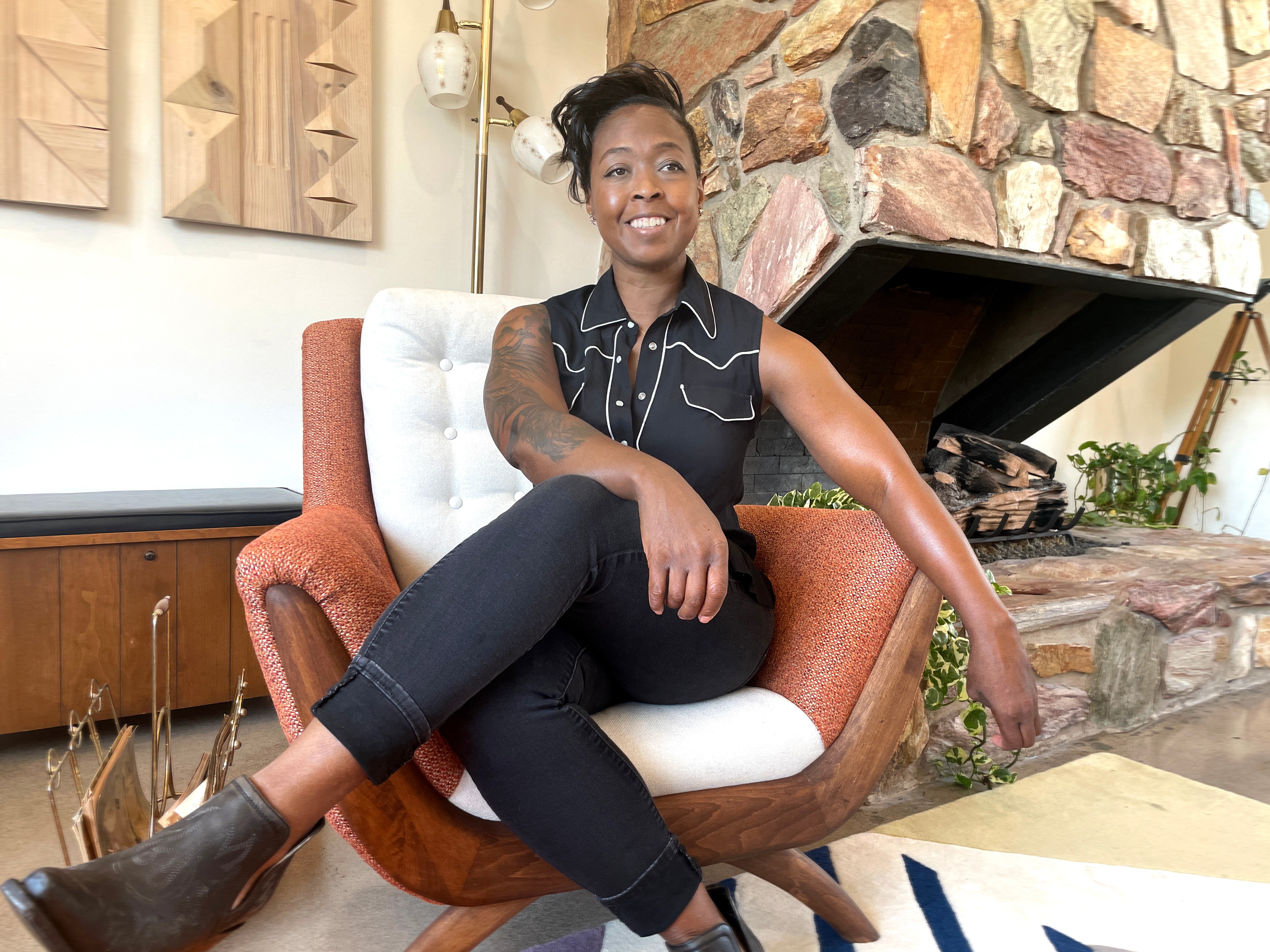
Shawnda Williams shared their story and experiences with us recently and you can find our conversation below.
Shawnda, we’re thrilled to have you with us today. Before we jump into your intro and the heart of the interview, let’s start with a bit of an ice breaker: What are you being called to do now, that you may have been afraid of before?
Sometimes the biggest leaps aren’t carefully planned; they’re pushed. Losing what I thought was my dream job forced a choice: be seen as overqualified in someone else’s company, or show up as invaluable in my own.
I’ve always been drawn to challenges that are a little scary and a lot ambitious. Sure, the doubters add fuel, but it’s usually that “What now?” moment — when life and uncertainty collide — that really moves me to action.
For years, I toyed with the idea of consulting. I picked up freelance gigs, worked in agencies, and soaked up every lesson I could about building a sustainable business. Despite all that preparation, I stayed in the cozy confines of a traditional role until life decided for me. Like many in tech, my dream job was abruptly cut short by layoffs. The job market was fierce, crowded with incredible talent who were similarly all grappling with displacement. I found myself at a crossroads: keep applying for roles and risk my 20+ years of experience being seen as “overqualified,” or bet on myself and leverage that experience as an asset and consult for my own business.
So I leapt. I turned Southern Fried Concepts—previously my side hustle and creative outlet rooted in hand-drawn design and getting your hands dirty—into a full-time consultancy. I preserved its creative soul while incorporating what I would ordinarily categorize as my “big kid” or “day job” skills: product and design strategy and experiential design. Drawing on my corporate expertise, I help brands solve problems in ways that keep the human at the center.
Taking this leap didn’t mean the fear disappeared. I’ve faced scrutiny and doubt before, but this time I had something powerful in my corner: my partner, Carmen. She’s been my rock, my voice of reason, and my guiding light—often the person pushing me forward when I needed it most. She even doubled down and leveraged her own professional standing to support my journey, and I’m as much in awe of her unwavering support as I am appreciative of it.
A year in, it’s still absolutely terrifying. But I’ve never felt more aligned. I’m not just surviving; I’m building something I believe in. And consulting gives me the freedom, the challenge, and the control to keep doing exactly that.
Can you briefly introduce yourself and share what makes you or your brand unique?
I’m the founder and principal consultant behind Southern Fried Concepts—a design strategy consultancy that blends product innovation, cultural relevance, and unapologetic creativity. After more than 20 years leading UX and product strategy for companies like Apple, Microsoft, Cisco, REI, Zappos, and General Dynamics, I launched my own consultancy to solve a problem I saw again and again: brands treating customers like data points instead of real people.
At Southern Fried Concepts, we believe great design happens when you bridge strategy with soul. Our work is rooted in a human-centered approach, helping companies create experiences that aren’t just functional but truly unforgettable. My focus is on remembering that the end user is a person whose life is surrounded by digital interactions. Their expectations, context, and the complexity they’re navigating—where they’re simultaneously an expert and a novice—are all influencers in the experience’s success or failure. I work across entire product ecosystems to remove unnecessary complexity, instill trust, and cultivate genuine fans through meaningful experiences.
My approach blends UX, product management, service design, and customer experience strategy to drive measurable growth—while still feeling deeply human. That might look like reimagining loyalty programs, guiding enterprise teams to rethink how they engage with customers, or mentoring small business owners through HUUB. No matter the scale, my belief is the same: when we design with empathy and intention, we build trust, and that trust leads to lasting loyalty.
Right now, I’m partnering with Ariat to evolve their loyalty program design, structure, strategy, implementation, and transition them to a more intelligent backend system. The goal? Make it easy for customers to earn points seamlessly for their transactions, and turn what would ordinarily be a purely transactional relationship into one that truly serves both the customer and the brand. It’s a great example of what thoughtful design can do when it’s aligned with business goals and customer needs.
Appreciate your sharing that. Let’s talk about your life, growing up and some of topics and learnings around that. What’s a moment that really shaped how you see the world?
When people ask about pivotal moments in my life, they usually expect a big career breakthrough or a life-changing conversation. But honestly, one of the most defining shifts in how I see the world happened in a garage, surrounded by a tribe of women who believed in my vision, working on a rusty old 1956 Chevy truck lovingly named High Yellow 56.
It started when I joined an all-female vehicle build called the Chevy Montage. I wasn’t a mechanic or a fabricator—I dabbled in the garage and was a far cry from the professionals I was working alongside, yet somehow I was welcomed into this rare experience to learn, try, and grow. That experience lit a fire and sparked an idea: what if I created my own build and restoration project? Still a newbie, but I understood design, knew how to lead creative projects, and believed in the power of bringing passionate people together. The success of the Chevy Montage showed me it was possible and inspired me to bring my vision of High Yellow 56 to life.
So I bought a beat-up 56 Chevy truck, pulled together a team of women from all over the country, secured sponsors, and set a wild goal: unveil at SEMA in just six months. That’s where my worldview really began to shift. The only requirement to join the team was being a woman—so we had everyone from master fabricators to women who had never picked up a screwdriver. This experience completely redefined how I understand human potential and collaboration. Extraordinary things happen when you create space for diverse perspectives to collide and complement each other. This opportunity organically paired experienced builders with newcomers, and unexpected lifelong friendships formed, fostering a resilient team spirit that proved something profound: when people feel psychologically safe and are genuinely valued, they will move mountains.
What we built together wasn’t just a truck; it was a living example of what’s possible when people feel safe, seen, and valued. In 2019, we rolled High Yellow 56 onto the main stage at SEMA, brought to life by an 80-person, all-female crew spanning every skill level and background you can imagine. That project taught me something foundational about leadership. It’s not about asking, “Are they qualified?”—because honestly, I wasn’t “qualified” either. But I had a vision. And that humility created space for everyone to step up and bring their unique strengths.
Whether I’m redesigning a loyalty program or improving a digital experience at Southern Fried Concepts, I carry that lesson with me: build cultures of psychological safety, embrace diverse voices, and always center the human story we’re building together.
If you could say one kind thing to your younger self, what would it be?
So much of childhood revolves around trying to fit in and belong. I would tell my younger self that it’s absolutely okay to be the “only”—and that it may just be your superpower.
I was never different for the sake of being different; it was a natural result of my childhood experiences. I grew up as what’s commonly known as an “Air Force brat,” which meant moving every two to three years to a new base in a new place. It was often a culture clash as we exchanged one coast for another, experiencing the diaspora of U.S. regional differences—never staying long enough to be a local, but encountering enough to shape a worldview that was mature beyond my years and uniquely mine. That kind of transience manifests in unexpected ways: clothes that don’t quite fit the local trends, hobbies that seem unfamiliar to others, and ideas that come off a little too “out there.” It made fitting in hard. I experienced a disproportionate amount of ridicule throughout my childhood, whether for the way I spoke or how I dressed.
However, what made it most endurable was my mom’s unconditional love and support. She helped me see greatness in my differences and nurtured my talents, even when I found myself in environments where I was scrutinized and made to feel as though my existence was a hindrance.
Although she couldn’t shield me from the harsher world I had to navigate, she provided unwavering love and guidance. So, while the world was actively trying to tear me down, she was building me up and instilling self-confidence. I’m grateful for her presence because every “oddball” idiosyncrasy became part of the blueprint that shaped me into the person and the professional I am today. Those differences that once felt isolating, my creativity, empathy, and strategic insight are precisely what allow me to see solutions that others miss, engage meaningfully with diverse audiences, and bring a unique perspective to the work I do. Being “an only” taught me resilience, adaptability, and the courage to stand confidently in my uniqueness.
And I wouldn’t change it for anything.
Alright, so if you are open to it, let’s explore some philosophical questions that touch on your values and worldview. What are the biggest lies your industry tells itself?
Here’s the problem — my industry treats “data” like it’s the whole truth. One of the biggest lies we tell ourselves is that data is objective, and that it’s enough on its own. We throw around the word “data-driven” like it’s a badge of honor, but too often, we treat “data” as if it only means numbers. And when we strip out the qualitative side of the conversation, we flatten people into one-dimensional data points.
That’s where the danger comes in. Once you reduce people to numbers, it’s easy to start optimizing for the metric instead of the human experience. I’ve seen brands hit every KPI and still lose customer trust because they never asked why the behavior was happening. A loyalty program can show perfect redemption rates on paper, but feel manipulative or transactional to the actual human using it.
At Southern Fried Concepts, I take a different approach: data-informed, but human-led. Quantitative insights reveal the patterns; qualitative signals bring the people behind those patterns into focus. That balance is what turns good metrics into genuine loyalty.
Okay, so before we go, let’s tackle one more area. When do you feel most at peace?
Once upon a time, before work and profession were ever a choice or requirement, I was just a kid who liked to draw and make things. One of my favorite childhood activities was something I called “hammer & nail”—a three or four-year-old version of myself armed with imagination, a tack hammer, piles of wood scraps, and nails, banging them into indiscernible creations.
Fast-forward to today, and the activities that bring me the most peace haven’t changed. I’m a huge proponent of reconnecting with the tactile world and engaging our hands, so naturally, the moments I feel most at peace are when I’m drawing or doing carpentry, when my hands are creating something tangible.
So much of my professional life is spent talking about solutions or, at best, doing nothing more laborious than keystrokes in a design application or sketches in a notebook. There’s something deeply renewing and gratifying about returning to my roots and delving into the tangible world. When I’m sanding wood or translating a drawing into a physical object—whether it’s a dog bed for my dog or shelves for my girlfriend—I’m connected to that little girl with the hammer, completely present, completely myself.
But this isn’t just personal therapy, it’s professional development. The problem-solving, spatial reasoning, and attention to craft quality that woodworking demands are the same skills I bring to every design challenge. Whether I’m figuring out how a joint will hold or how a brand will connect with its audience, it’s the same fundamental process of navigating constraints and transforming abstract ideas into functional reality.
I often refer to myself as a “designer of things” because I believe passionately in Massimo Vignelli’s philosophy: “If you can design one thing, you can design everything.” The hands-on making keeps me grounded in what good design really means, the relationship between form and function, the importance of craft, and the honesty of materials.
It’s in those moments of making, when I abandon the computer and it’s just me, my hands, and raw materials, that I find my center and ultimately my peace. That connection to our most basic humanity, to the act of creating something real with our hands—that’s at the heart of why I started Southern Fried Concepts in the first place. In a world increasingly dominated by digital distractions, it’s a wonderful respite to have these moments and, in my case, reconnect with the little girl who did everything with her hands and reignite the relationship between hand and brain.
Contact Info:
- Website: https://www.southernfriedconcepts.com
- Instagram: https://www.instagram.com/southernfriedconcepts/ and https://www.instagram.com/highyellow56/
- Linkedin: https://www.linkedin.com/in/shawndaw/